
Table of Contents
This Sun Home Solstice Portable infrared sauna review covers:
Indoor far infrared 1-4 person saunas available through Sun Home Saunas.
This guide provides educational information for selecting portable infrared sauna kits. Some links may be affiliate links, meaning this site may earn commissions on purchases at no additional cost to you.
- Solstice™ 1-Person Infrared Sauna
- Solstice™ 2-Person Infrared Sauna
- Solstice™ 3-Person Infrared Sauna
- Solstice™ 4-Person Infrared Sauna
The Solstice is a full wood cabin that comes in panels. You gather it at home (no power tools needed, which is actually pretty cool), but once it’s up, it’s not something you’re folding up after each session.
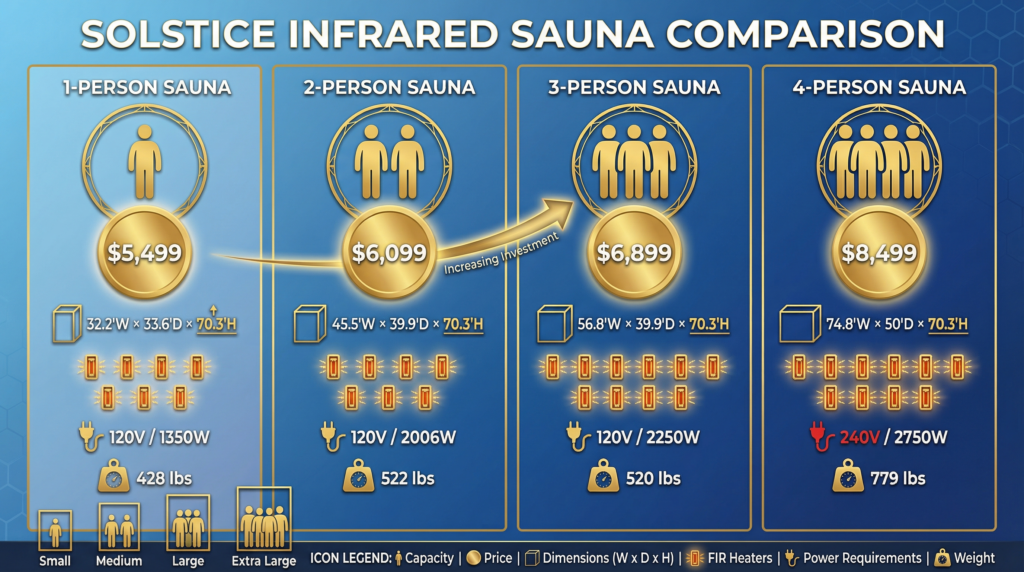
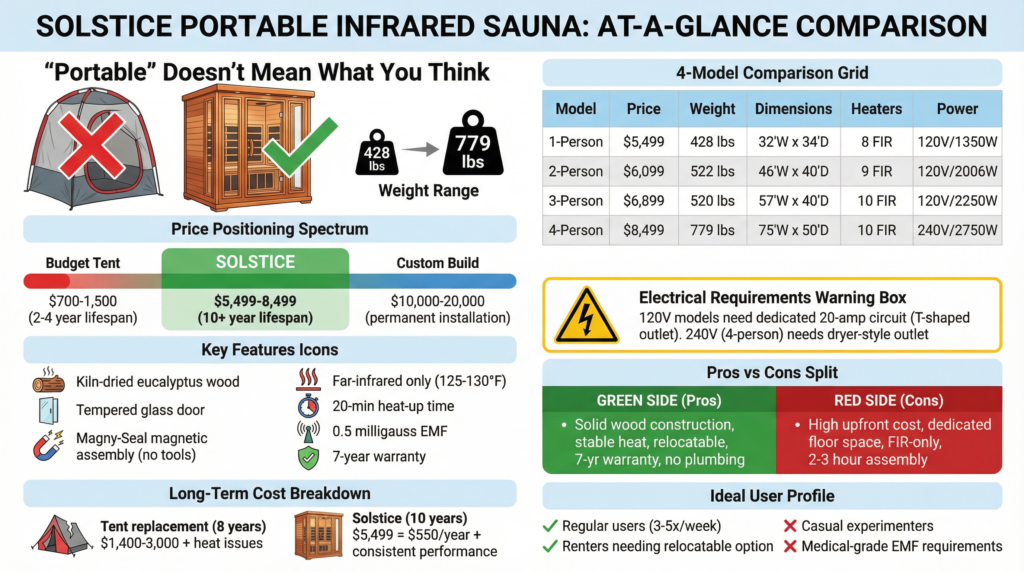
It weighs anywhere from 428 pounds for the 1-person model to 779 pounds for the 4-person unit.
So yeah, “portable” here means you can move it if you relocate apartments or houses, not that you’re breaking it down every weekend.
The starting price is $5,499 for the smallest model. The 4-person version hits $8,499.
That puts it way above those $700-1,500 fabric tent saunas but well below the $10,000-20,000 custom permanent installations that need contractors and electrical work.
The question I kept circling back to while researching this thing is whether you actually get meaningful differences for that price jump, or if it’s just fancy marketing on what’s basically the same experience as a cheap portable unit.
What You’re Actually Getting
The Solstice series uses solid wood construction. Specifically, eco-certified kiln-dried eucalyptus, which matters because cheaper wood warps when exposed to heat and moisture repeatedly.
The kiln-drying process (where they heat-treat the wood to remove moisture) prevents that warping issue. You also get tempered glass doors, which is a nice touch compared to the zippered fabric flaps on tent models.
The thing ships in flat panels. Sun Home uses this magnetic locking system they call Magny-Seal instead of screws or nails.
From what I can gather, two people can get it assembled in a few hours without needing tools, though the panels are heavy so it’s not exactly a fun afternoon project.
Interior size varies a lot depending on which model you’re looking at.
The 1-person unit has an interior footprint of 32.2 inches wide by 33.6 inches deep. That’s tight but workable for solo sessions.
The exterior dimensions are bigger (37.8″ x 39.8″) because of the wall thickness.
The 2-person model bumps up to 45.5 inches wide by 39.9 inches deep inside, which gives you room to stretch out a bit more or actually fit two people without being jammed together.
The 3-person version goes to 56.8 inches wide, and the 4-person stretches to nearly 75 inches wide and 50 inches deep. That last one needs a dedicated room, honestly.
Not something you’re squeezing into a bedroom corner.
One thing that tripped me up at first is the clearance requirements. You need 4-6 inches of space around all sides of the sauna and 8-10 inches above the roof for air circulation.
So if you’re planning this for a tight corner in your apartment, measure carefully because the actual floor space you need is bigger than just the sauna dimensions.
The Heating System
All Solstice models use far-infrared (FIR) heating exclusively. They don’t do near-infrared or mid-infrared like some of the ultra-premium brands.
Far-infrared operates at lower air temperatures (usually around 125-130°F) compared to traditional steam saunas that hit 200°F. The idea is that FIR penetrates deeper into tissue without making the air so hot you can’t breathe comfortably.
The number of heaters scales with cabin size. The 1-person model has 8 FIR panels distributed around the walls and back.
The 2-person has 9 panels, the 3-person has 10, and the 4-person also has 10 but they’re more powerful.
Wattage matters here because it decides how fast the cabin heats up and how stable the temperature stays during your session.
The 1-person pulls 1,350 watts, the 2-person uses 2,006 watts, and the 3-person draws 2,250 watts. All three of those plug into standard 120V household outlets (but you need a dedicated 20-amp circuit, which I’ll get to in a sec).
The 4-person is different. It needs 240V at 2,750 watts, which means you probably need an electrician to set up the right outlet unless you already have one in that room.
That’s an extra cost to factor in.
Heat-up time runs about 20 minutes to get to therapeutic temperatures, depending on how cold your room is to start. That’s honestly faster than I expected compared to some tent units that take 40+ minutes.
EMF Levels and Safety Stuff
EMF (electromagnetic field) concerns come up constantly in sauna shopping. Sun Home lists the Solstice as ultra low EMF exposure, which is lower than most household appliances.
If you’re looking for medical-grade certification, this might not be the right fit.
Materials-wise, everything is FDA-approved and low-VOC (volatile organic compounds), which matters when you’re sitting in an enclosed heated box breathing deeply. Cheap materials off-gas when heated, and that’s not something you want happening while you’re trying to relax.
Electrical Requirements (This Part Actually Matters)
Most people gloss over this section but it’s important.
The 1-person, 2-person, and 3-person models all run on 120V, which is standard household voltage. But they need a dedicated 20-amp circuit.
That means you can’t just plug this into any random wall outlet. If you plug a 20-amp device into a shared 15-amp circuit (which most bedroom outlets are), you’ll trip breakers or worse.
Most modern homes have at least one or two 20-amp circuits, usually in the kitchen or garage. You can tell by looking at the outlet… 20-amp outlets have a T-shaped neutral slot.
If you don’t have one in the room where you want the sauna, you’ll need an electrician to add one.
The 4-person model needs 240V, which is what your dryer or oven uses. That’s a bigger electrical job if you don’t already have a 240V outlet in your sauna location.
This is a huge advantage over traditional custom sauna builds that often need extensive electrical work. But it’s not quite plug-and-play if your apartment or house doesn’t have the right outlet already.
Performance Stuff
The biggest functional difference between a solid cabin like the Solstice and fabric tent units is heat retention.
Insulated wood walls hold temperature way better than fabric stretched over a frame. Tent saunas lose heat constantly because fabric doesn’t insulate well, so the heating elements work overtime trying to maintain temperature and you still get fluctuations.
The Solstice cabins maintain stable internal temps once they heat up. The enclosed construction and distributed heater placement (8-10 panels depending on model) create more even heat distribution compared to tent units that usually have 2-3 centralized heating elements.
Session comfort is noticeably different in a cabin versus a tent setup. In a tent sauna, your head sticks out the top, which means your upper body is exposed to room-temperature air while your lower body sweats.
Some people like that, but it creates uneven heat exposure.
In a full cabin, you’re fully enclosed. The bench height is 19.5 inches from the floor with a 20.2-inch depth across all models, which supports upright sitting posture. You can adjust your position, stretch out a bit (depending on cabin size), and the heat exposure is consistent.
Durability is where the price difference really shows up. Fabric portable units typically last 2-4 years before zippers fail, fabric tears, or heating elements burn out.
Solid wood cabins with properly installed FIR panels should last 10+ years easily. Sun Home claims the heaters themselves are rated for 30,000+ hours of operation, which works out to something like 100 years of daily use.
That’s probably marketing math, but the point is the heaters aren’t the weak point.
The warranty backs this up… 7 years on the cabinet and heaters, 3 years on controls, plus a limited lifetime component on the cabinet structure itself.
| Model | Price | Interior Dimensions | Heaters | Voltage | Weight |
|---|---|---|---|---|---|
| Solstice 1-Person | $5,499 | 32.2″W x 33.6″D x 70.3″H | 8 FIR | 120V / 1350W | 428 lbs |
| Solstice 2-Person | $6,099 | 45.5″W x 39.9″D x 70.3″H | 9 FIR | 120V / 2006W | 522 lbs |
| Solstice 3-Person | $6,899 | 56.8″W x 39.9″D x 70.3″H | 10 FIR | 120V / 2250W | 520 lbs |
| Solstice 4-Person | $8,499 | 74.8″W x 50″D x 70.3″H | 10 FIR | 240V / 2750W | 779 lbs |
What Works and What Doesn’t
The good stuff:
We are not talking about one of those lower cost tents. These are premium grade cabins. Solid wood, tempered glass, proper insulation… these aren’t just cosmetic upgrades.
They directly impact how well the sauna maintains temperature and how long it lasts.
Heat distribution and stability are consistent. Once the cabin reaches target temperature (usually 20-ish minutes), it stays there without constant fluctuation.
That matters for longer sessions where you want steady heat exposure.
No plumbing required, and most models work on standard 120V household power (with the caveat about needing a dedicated 20-amp circuit). That removes a massive barrier compared to custom installations.
The modular design means you can relocate it if you move. It’s not a fun process (disassembly and reassembly takes time), but it’s possible.
That’s important for renters.
Multiple size options let you match the cabin to your space constraints. The 1-person fits in spaces where a 3-person would be impossible.
Chromotherapy lighting and Bluetooth audio are included. These are nice-to-have features, not deal-breakers if missing, but they add to the experience.
7-year warranty on the main components shows manufacturer confidence. Most cheap portable units have 1-2 year warranties max.
The limitations:
$5,499 is a lot of money compared to $700-1,500 fabric tents but if that seems like a lot to you Sun Home does offer a portable infrared blanket starting at $499 as an entry level infrared system to get you into one and they are great quality . The question is whether the durability and performance differences in the cabin justify spending 4-6x more for a cabin or if a blanket can suffice.
Plus with cabins you need dedicated floor space. This isn’t something you set up and take down as easy as an infrared blanket.
Once it’s assembled, it’s a permanent fixture in whatever room you put it in (unless you go through the hassle of disassembling).
EMF levels are consumer-safe but not medical-grade zero-EMF. If that’s a priority, you’re looking at more expensive brands with specialized shielding.
Far-infrared only. No near or mid-infrared wavelengths. If that is what you want then upgrade and look into the Eclipse and Equinox.
Some premium systems offer full-spectrum infrared, which may provide extra benefits (though the research on that is still developing).
Assembly takes 2-3 hours least with two people. The panels are heavy (the whole 4-person unit is 779 pounds).
It’s not technically difficult, but it’s labor-intensive.
Relocation is possible but annoying. If you move apartments every year or two, the reassembly hassle might outweigh the benefits.
Who This Makes Sense For
The Solstice lineup hits a specific niche.
If you are an urban dwellers or have a small apartment the Solstice is a perfect fit if you have the budget.
If you’ve been frustrated with cheap portable tents that lose heat, develop mechanical issues after a year, or just feel flimsy during use, the solid cabin construction addresses those pain points directly.
If you’ve looked at $10,000-20,000 custom sauna installations and thought “I don’t have that budget or the ability to do permanent construction in my rental,” the Solstice offers a middle path.
For people who want consistent infrared therapy at home without the complexity of a full renovation project, this positioning makes sense.
It’s less ideal if you’re on a tight budget and just want to try infrared therapy casually. In that case, a $1,000 tent unit might be a better starting point (even if it doesn’t last as long).
It’s also less ideal if you’re a serious biohacker looking for cutting-edge features like full-spectrum infrared, medical-grade EMF shielding, or app-controlled programming. Those features exist in $8,000-15,000 systems, but not with the Solstice. Look into the Eclipse and Equinox made by Sun Home Saunas.
The Solstice sits in the middle… better than entry-level, more accessible than ultra-premium.
The Price Question
A realistic comparison looks like this:
Budget fabric tent saunas ($700-1,500) are cheaper upfront but typically last 2-4 years. If you replace one twice over 8 years, you’re spending $1,400-3,000 total plus dealing with inconsistent heat and mechanical issues.
The Solstice 1-person at $5,499 should last 10+ years with proper use. Amortized over a decade, that’s roughly $550/year versus $350-750/year for replacing cheap units.
But the real comparison isn’t just cost per year. It’s whether the experience is meaningfully better.
Stable heat, faster warm-up, longer lifespan, better build quality… those differences exist.
Whether they’re worth the premium depends on how much you’ll actually use the sauna and how important consistent performance is to you.
Custom permanent installations ($10,000-20,000) offer the best performance and customization but need construction, dedicated electrical work, and permanent space allocation. If you’re renting or might move in the next few years, that investment doesn’t make sense.
Ultra-premium modular systems ($8,000-15,000) from brands like Sunlighten or Clearlight offer full-spectrum infrared, zero-EMF certification, and advanced controls. The Solstice trades those features for a lower entry price.
If you’re leaning toward trying one of these, start by measuring your space carefully (including clearance requirements) and confirming you have the right electrical outlet. The 1-person model is the lowest-risk entry point for testing whether regular sauna use fits your routine.
Final Take
This Solstice portable infrared sauna review kept circling back to one core question… is the cabin construction and stable heating worth spending 4-6x more than a fabric tent?
For casual users who might use a sauna once a week or less, probably not. The tent units are good enough for occasional use, and the cost difference is hard to justify.
For people planning regular sessions (3-5+ times per week), the durability and consistent performance differences become more meaningful. Better heat retention, faster warm-up, and a 10+ year lifespan change the value equation.
The Solstice series fills a real gap. It’s the pragmatic option for people who want serious home infrared access without the permanent installation headaches or ultra-premium price tags.
It’s not the cheapest option, and it’s not the most advanced. But for renters, apartment dwellers, or anyone who wants plug-and-play infrared therapy that actually maintains temperature properly, this middle-tier positioning makes sense.
Check current pricing and model availability directly to see real-time inventory and any seasonal promotions before committing. The 2-person model at $6,099 seems like the best balance of space efficiency and functionality for most people, assuming you have the room for the 50.9″ x 45.9″ exterior footprint plus clearance.
The 1-person works if space is really tight or you’re absolutely sure it’s solo-use only. The 3-person and 4-person models need dedicated rooms and make more sense for families or people with large homes.
Compare all four models side-by-side with full specs to match your space constraints and usage plans. The jump from 1-person to 2-person is only $600 but gives you significantly more interior room and flexibility.
The core product addresses real problems with portable tent units (heat loss, durability, inconsistent temps) and avoids the major barriers of custom builds (permanent installation, high cost, electrical complexity).
Whether that’s worth $5,500-8,500 depends on how much you value consistent home infrared access and how long you plan to use it. For someone committing to 5+ years of regular sessions, the math probably works.
For casual experimenters or people who might move often, it’s a tougher call. A better option may be the portable infrared blanket they offer.
Review the electrical requirements for your specific model choice before buying to avoid surprises during setup. The 120V models need a dedicated 20-amp circuit, and the 4-person needs 240V.
Getting that sorted ahead of time saves headaches later.
This guide provides educational information for selecting portable infrared sauna kits. Some links may be affiliate links, meaning this site may earn commissions on purchases at no additional cost to you.