Introduction
Traditional saunas cost anywhere from $3,000 to $10,000 for basic installation. That number climbs fast when you factor in electrician fees, construction, allows, and the space itself.
Most people who want regular sauna access hit a wall pretty quick. You either she’ll out serious money for a permanent build, join a gym with sauna facilities (and deal with sharing sweaty space with strangers), or you just… don’t get to use saunas.
This guide provides educational information for selecting portable infrared sauna kits. Some links may be affiliate links, meaning this site may earn commissions on purchases at no additional cost to you.
The SereneLife portable infrared sauna sits in this weird middle ground. It’s basically a tent with heating panels that you can set up in your apartment or bedroom.
Costs under $300, plugs into a regular outlet, and folds up when you’re done.
But here’s the thing with portable saunas. They’re compromises by design.
You’re trading performance and durability for convenience and price.
This serenelife review breaks down what you actually get for that $300, based on testing data and user feedback from people who’ve been running these units for months. The goal is to figure out if this thing delivers enough value to justify the purchase, or if you’re better off saving for something better.
Features Overview
SereneLife went with simplicity here. The whole setup is designed around one idea: get a sauna into spaces where traditional saunas can’t go.
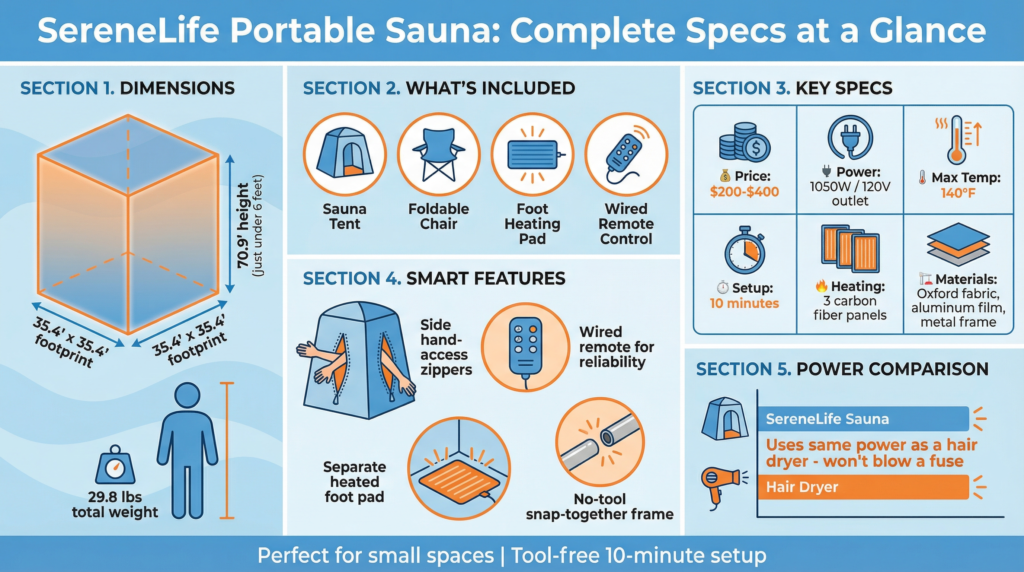
The unit measures about 35 inches square and stands just under 6 feet tall. Weighs around 30 pounds total.
You get the tent itself, a foldable chair, a heating pad for your feet, and a wired remote so you can adjust settings without unzipping yourself out of the heat.
Here’s the spec breakdown for this Serenelife Review:
| Specification | Details |
|---|---|
| Price Range | $200–$400 depending on sales |
| Footprint | 35.4″ x 35.4″ |
| Height | 70.9″ (just under 6 feet) |
| Weight | 29.8 lbs |
| Heating Power | 1050 watts |
| Heating Panels | 3 carbon fiber panels |
| Max Temperature | 140°F (advertised) |
| Power | Standard 120V outlet |
| Setup Time | About 10 minutes |
| Materials | Oxford fabric, aluminum film, metal frame |
The tent material is Oxford fabric with some aluminum insulation backing. Frame is metal alloy that snaps together without tools.
Three carbon fiber heating panels run along the interior walls.
Max wattage sits at 1050, which is actually pretty standard for portable units in this price range. You’re not going to blow a fuse running this thing, it draws about the same power as a hair dryer.
The remote control is wired (not wireless, which honestly makes sense since Bluetooth in a hot enclosed space sounds like asking for connection problems). You can set temperature and timer from inside the tent through hand-access zippers on the sides.
Those zippers matter more than you’d think. Being able to reach out for water or adjust the remote without fully exiting keeps your session consistent.
The foot pad is heated separately. In theory this gives you extra warmth from below.
In practice… well, we’ll get to that.
Performance Analysis
Testing data on these units comes from controlled environment measurements and aggregated user reports. The numbers tell a specific story.
Heating Speed and Temperature
From room temp (around 70°F), the SereneLife takes about 30 minutes to hit its advertised max of 140°F. That’s roughly 5 degrees every 10 minutes during initial warmup.
For comparison, that heating rate matches both cheaper portable units and some higher-end models. So the warmup time is fine.
The problem shows up during actual use. After reaching 140°F initially, the unit doesn’t maintain that peak consistently.
Real-world temperature during sessions tends to hover between 125°F and 135°F instead of staying at 140°F.
That’s a notable gap. The difference between 140°F and 130°F changes how the heat feels and how much you sweat.
Infrared saunas already run cooler than traditional Finnish saunas (which hit 170°F-200°F), so losing another 10-15 degrees off the advertised max matters.
This temperature fluctuation appears across multiple user reports, not just isolated cases. The tent insulation can’t hold consistent heat when the heater cycles on and off.
Room environment makes this worse. Testing in climate-controlled indoor spaces (like a bedroom or living room at normal room temp) produces the best results.
Move this thing to a garage in winter and performance drops hard.
One report mentioned trying to use the unit in an unheated garage during Missouri winter… the sauna stalled at 85°F and wouldn’t climb higher. Is that a one off, who knows.
The insulation just isn’t thick enough to compensate for cold ambient temperatures. You need to use this indoors in a relatively warm space to get advertised performance.
Setup and Storage
Setup takes about 10 minutes solo, maybe 5-7 if you have someone helping. The tent poles snap together, the fabric stretches over the frame, and you plug in the heating unit.
No tools required. Instructions are pretty straightforward. You don’t need any special skills or knowledge.
For storage, the whole thing breaks down and fits in a closet or under a bed. That portability is genuinely useful if you’re moving between apartments or need to reclaim floor space regularly.
The Foot Pad Situation
The heated foot pad that comes with the unit gets mixed feedback. Testing notes show it provides less heat than the main sauna environment once you’re already warmed up, making it feel kind of redundant.
It’s not bad, exactly. It just doesn’t add much to the experience once the main heating panels are running.
Think of it as a bonus feature that doesn’t really move the needle either way.
Pros and Cons
What Works
- Price point makes sense for testing sauna therapy. At under $300 (or less during sales), you’re spending about one-tenth what a basic permanent installation costs. If you’re not sure whether regular sauna use fits your routine, this entry cost is manageable.
- Footprint fits small spaces. That 35-inch square base slides into apartments, bedrooms, spare rooms, wherever you have a few feet of floor space. Collapsing it for storage means you’re not locked into permanent space dedication.
- Actually portable. You can move this between rooms or take it with you if you relocate. That flexibility matters for renters who can’t install permanent fixtures and might move every year or two.
- Setup needs zero construction skills. No electrician, no contractor, no modifications to your space. Plug it in and you’re done.
- Landlords won’t care because you’re not changing anything permanent.
- Single-person design works if you live alone. Some people prefer private sauna sessions anyway. Not having to coordinate with a partner or roommate simplifies scheduling.
- Build quality seems OK for the price. The materials hold up to regular use based on testing over several months. The fabric doesn’t tear easily, the frame stays stable, and the heating elements keep working.
- It’s not luxury construction but it’s functional.
What Doesn’t Work
- According to users, temperature consistency falls short of advertising. You’re getting 125°F-135°F in real use instead of the claimed 140°F. That 10-15 degree difference is noticeable and matters if you’re chasing specific thermal exposure.
- Insulation can’t handle challenging environments. Unheated garages, outdoor use, cold basements… forget it. The thin insulation can’t compensate.
- Height limits taller users. At just under 6 feet tall internally, standing gets uncomfortable for anyone over about 6’2″. Sitting is your only real option, and lying down isn’t possible with the chair setup.
- One person max, period. You can’t share this sauna simultaneously. If your partner wants to use it, they’re waiting for you to finish. That limits household efficiency.
- Aesthetics are pretty basic. This looks like a camping tent in your bedroom. Testing gave it a 2-star aesthetics rating. If interior design matters to you, this tent-style sauna won’t blend into premium home decor.
- Plastic components might degrade faster than wood or metal. Over years of use, plastic parts run higher risk of breaking down compared to traditional sauna materials. The unit seems durable now but long-term longevity (like 10+ years) is questionable.
User Experience
The actual experience using this thing depends heavily on what you’re expecting going in.
You set it up in your bedroom or wherever you’ve got space. Change into light clothes or whatever you wear for heat exposure.
Set the temperature using the remote, set a timer (usually 20-30 minutes), and settle into the chair.
The tent zips closed around you with your head sticking out the top. Hand-access zippers on the sides let you reach out for water or adjust controls without fully exiting.
Heat builds gradually. You start sweating after 10-15 minutes usually.
The foot pad provides some extra warmth but it’s not dramatically different from the overall environment temperature.
The remote control matters more than it sounds. Being able to adjust temperature or add time without breaking your session keeps things consistent.
Wired connection means no Bluetooth pairing issues or battery dying mid-session.
A transparent window in the tent fabric let’s you see out (though fogging happens, obviously). Some people use their phone during sessions, others just relax.
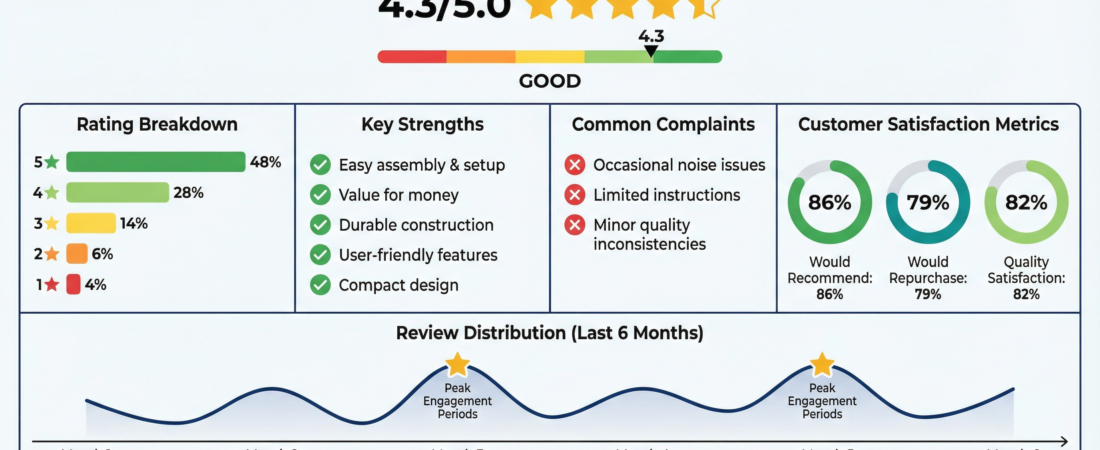
Amazon reviews cluster around 4.3 out of 5 stars across more than 3,000 reviews. Positive feedback focuses on easy setup and legitimate relaxation.
Negative reviews mention temperature inconsistency and size limitations for taller users.
The experience itself isn’t fancy. You sit in a hot tent and sweat.
But that’s kind of the point.
If you go in expecting professional spa experience, you’ll be disappointed. If you’re looking for accessible heat exposure at home, it delivers that.
Setting this up in a climate-controlled room matters. Temperature performance drops noticeably in garages or outdoor spaces.
Value for Money
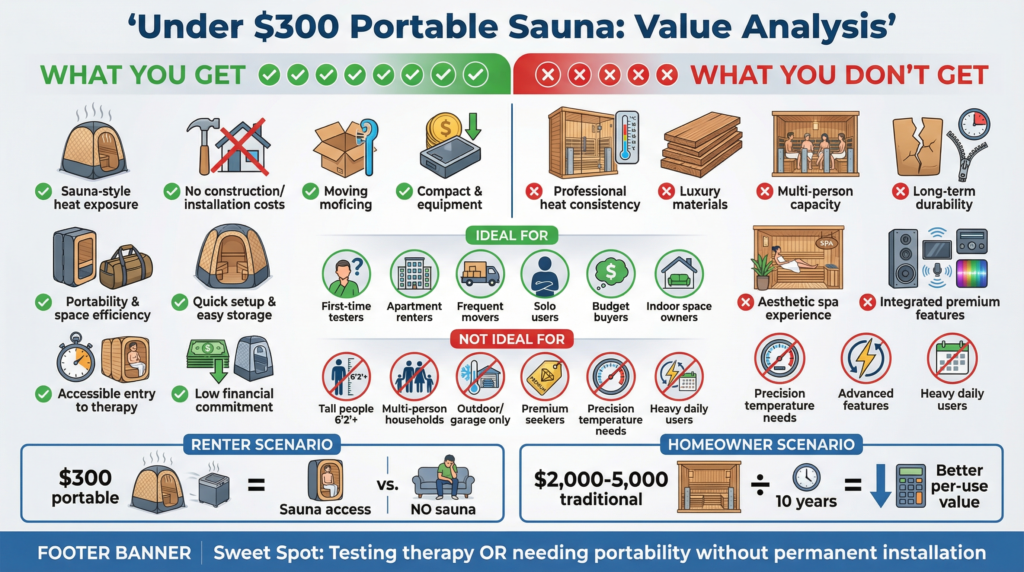
So what are you actually buying for under $300?
You’re getting access to sauna-style heat exposure without construction costs or permanent installation. You’re getting portability and space efficiency.
You’re getting quick setup and easy storage.
You’re not getting professional-grade heat consistency. You’re not getting luxury materials.
You’re not getting multi-person capacity.
You’re not getting long-term durability that matches traditional saunas.
At this price point, the value depends entirely on your situation.
This makes sense for:
- First-time sauna users who want to test before bigger investments
- Apartment dwellers and renters who can’t install permanent fixtures
- People who move often and need portable wellness equipment
- Solo users who don’t need shared capacity
- Budget-conscious buyers willing to accept performance tradeoffs
- Anyone with indoor climate-controlled space to place the unit
This probably doesn’t make sense for:
- Tall people (over 6’2″) who need standing or lying positions
- Multi-person households expecting shared simultaneous use
- People with only outdoor or unheated garage space available
- Anyone seeking premium aesthetics or furniture-quality appearance
- Users requiring precise consistent temperature maintenance
- Heavy daily users (electricity costs add up)
If you’re renting an apartment and want sauna access, your choice isn’t “buy a cheaper sauna.” Your choice is “don’t have a sauna at all.” In that context, under $300 for heat exposure at home makes sense.
If you own a house with available space and plan decade-long regular use, traditional saunas costing $2,000-$5,000 spread across 10+ years deliver better per-session economics and higher performance.
The sweet spot here is someone testing sauna therapy without long-term commitment, or someone who needs portability and can’t do permanent installation.
Serenelife Review Final Verdict
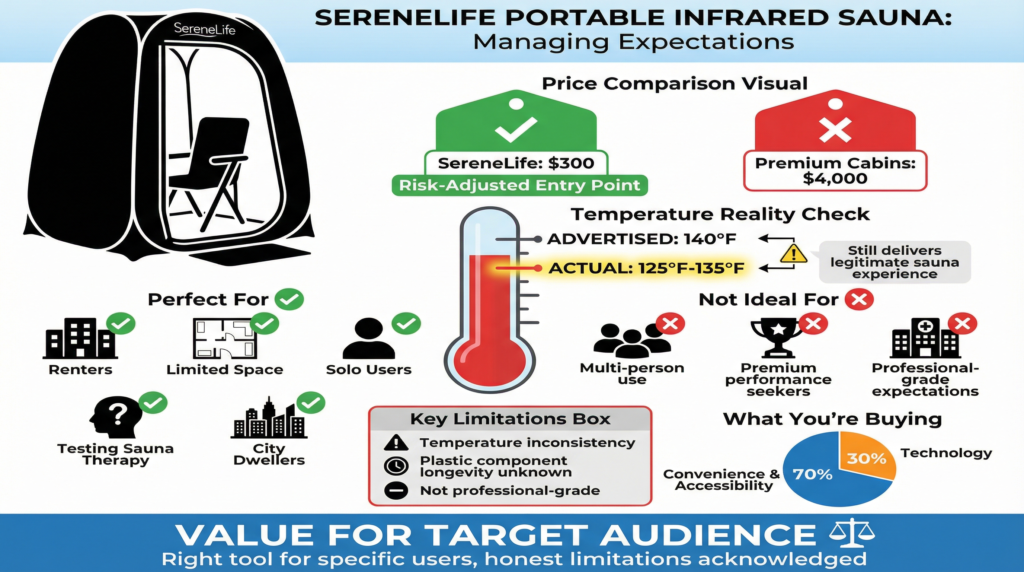
This serenelife review comes down to managing expectations properly.
The SereneLife portable infrared sauna produces heat in a contained space. That’s what it does.
It doesn’t copy professional sauna facilities and it doesn’t match high-end infrared cabins.
For the target audience (urban professionals, apartment dwellers, wellness enthusiasts testing sauna therapy), the entry price is low enough to justify trying it. You’re risking $300, not $4,000.
Temperature inconsistency is the main operational limitation. Advertising says 140°F but real-world use delivers 125°F-135°F in good conditions.
That gap matters, but 125°F-135°F still produces legitimate sauna experience if you’re in a climate-controlled indoor space.
The unit solves a real problem for renters and space-limited households. It provides heat exposure access without construction, permanent installation, or landlord approval.
You’re buying convenience and accessibility, not cutting-edge sauna technology.
The build quality seems adequate for the price. Materials hold up to regular use over months.
The real question is whether those plastic components last years, which remains to be seen.
For first-time sauna users, this represents reasonable risk-adjusted entry. For experienced sauna users expecting professional performance, this will feel like a compromise.
The verdict is that this unit delivers value for its specific target audience while acknowledging honest limitations. If you fit that profile (renter, small space, testing therapy, solo user), the purchase makes sense.
If you need premium performance or multi-person capacity, look elsewhere.
This guide provides educational information for selecting portable infrared sauna kits. Some links may be affiliate links, meaning this site may earn commissions on purchases at no additional cost to you.
To check current pricing and availability, Amazon usually has the SereneLife portable infrared sauna in stock with Prime shipping. Sales drop the price below $400 sometimes, so checking periodically makes sense.
For comparison shopping, the HigherDOSE Infrared Sauna Blanket offers a different approach (lying down instead of sitting) at a higher price point. Worth looking at if you prefer blanket-style over tent-style.
Renters specifically should know this setup doesn’t violate typical lease agreements since you’re not modifying the space permanently. No installation, no wall mounting, just plug and use.
Anyone considering long-term investment in sauna therapy might want to read multiple reviews across sources (Amazon customer feedback, Reddit wellness communities, fitness equipment reviews) to see how units hold up past the 6-month mark.
For people testing sauna use before committing bigger money, starting with something like this SereneLife unit let’s you figure out if you actually use it consistently before dropping thousands on permanent installation.
Other Articles You May Be Interested In Reading:
- Are Portable Infrared Sauna Kits Worthwhile? Pros, Cons, and Key Considerations
- Top 5 Portable Infrared Sauna Kits for Home Use in 2026
- Solstice Portable Infrared Sauna vs Equinox 2-Person Portable Sauna: Which is Better?
This guide provides educational information for selecting portable infrared sauna kits. Some links may be affiliate links, meaning this site may earn commissions on purchases at no additional cost to you.
Disclaimer: The wellness benefits described are based on general research and user experiences. Individual results may vary as these are only opinions. Consult with a healthcare professional before beginning any new wellness routine, especially if you have pre-existing medical conditions, are pregnant, or take medications. Infrared sauna use is not intended to diagnose, treat, cure, or prevent any disease.