
So you’re looking at portable infrared sauna kits for your place. Smart move, honestly.
These things have gotten really popular lately, and for good reason. No construction crew, no permanent installation, no landlord freaking out about modifications to the apartment.
You basically get most of the benefits of a traditional sauna without the nightmare of actually building one.
But here’s where it gets tricky… there are like a million options out there now. Some are $200, some are $2,000+.
Some claim zero EMF (we’ll get into that), others don’t mention it at all.
And the reviews? They’re all over the place. Make it easy on yourself and use our portable infrared buyers tool!
Table of Contents
Understanding the Basics

What Makes Infrared Different
Regular saunas heat up the air around you. It’s hot, it’s steamy, and tbh it can be pretty intense.
Infrared saunas work differently. They use infrared light waves to heat your body directly instead of cooking the air first.
The temperature stays lower (usually 120-140°F instead of 180-200°F), but you still sweat like crazy.
There are three types of infrared: near, mid, and far. Most portable units use far-infrared because it penetrates deeper into tissue.
Some fancier models have all three (they call it “full spectrum”), but you’ll pay more for that.
Why People Go Portable
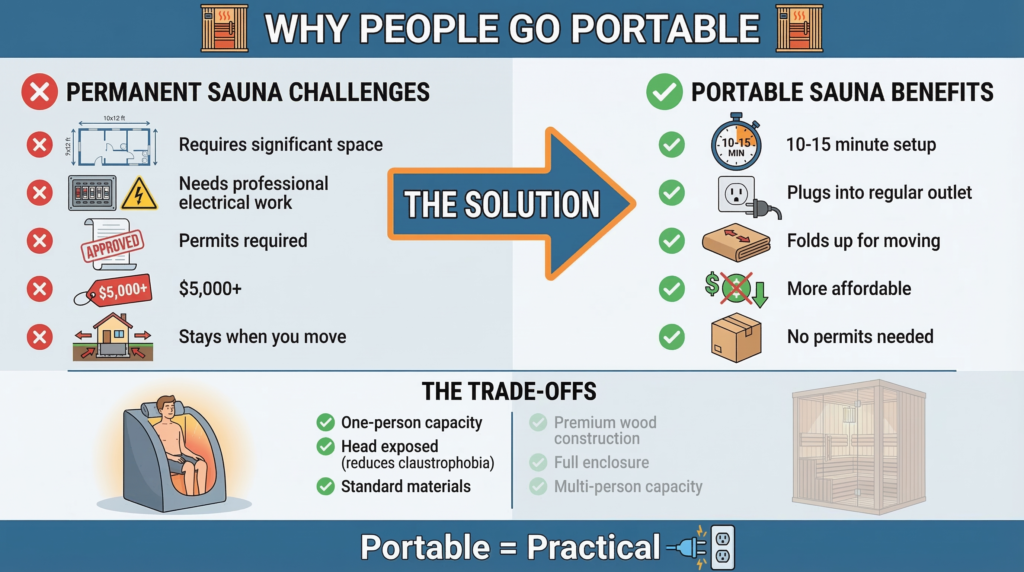
The permanent sauna thing just doesn’t work for most people. You need space, you need electrical work, you probably need allows… it’s a whole thing.
Portable infrared sauna kits changed the game because they’re basically plug-and-play. You set them up in like 10-15 minutes, plug them into a normal outlet, and you’re good to go.
When you move apartments or houses, you just fold it up and take it with you.
The trade-off is they’re usually one-person units with your head sticking out (which honestly some people prefer anyway because claustrophobia is real). And the materials aren’t as high-end as a wooden sauna cabin that costs $5,000+.
Key Considerations
Size and Space Requirements
Most portable units need about 3×3 feet of floor space. Some are a bit bigger, some are more compact.
You also need to think about ceiling height if you’re tall. The standard height is around 38-40 inches when set up, so measure twice before ordering.
And here’s something people don’t think about… where are you gonna store it when it’s not in use? Even folded up, these things take up space.
Some come with a carrying case, some don’t.
Check that before buying.
Heating Technology and Temperature Range
This is where brands really differ. The heating panels inside can be carbon fiber, ceramic, or a combination.
Carbon fiber panels heat up faster and distribute heat more evenly. They’re also thinner, which means more space inside the sauna.
Most quality units use carbon panels now.
Ceramic heaters are older technology. They work fine but take longer to reach temperature and can create hot spots (where one area is way hotter than another).
Temperature range matters too. Look for units that can reach at least 140-150°F.
Some cheaper models max out at 120°F, which might not be enough for what you’re trying to accomplish.
The EMF Safety Thing
Okay so this is where it gets confusing real fast. EMF stands for electromagnetic field, and all electronic devices emit some level of it.
Some companies make a huge deal about having “ultra low EMF” or “zero EMF” technology. Others don’t mention it at all.
Here’s the thing… there’s no standardized testing or regulation for this stuff in saunas. One brand says they’re under 3 milligauss (mG), another says under 5 mG, and you have no real way to verify either claim unless you buy an EMF meter yourself.
For context, your laptop emits 2-5 mG, your hairdryer emits 60-2000 mG depending on distance. Most experts say anything under 10 mG is pretty safe for extended exposure, but again, this isn’t heavily regulated.
If EMF is a concern for you (and it’s valid to care about this), look for brands that specifically test and publish their numbers. Some companies are way more transparent about it than others.
Materials and Construction Quality
The tent material is usually a multi-layer fabric with insulation in between. Better quality units have 3-4 layers with reflective interior coating to keep heat in.
Cheaper units might use thinner material that doesn’t hold temperature well. You’ll know this is happening when the heaters are running constantly but it never really gets hot enough inside.
The frame should be sturdy. Some use fiberglass poles, some use metal.
Metal is usually more stable but adds weight.
Check what the chair situation is too. Some kits include a foldable chair, some expect you to use your own.
Make sure whatever chair you use can handle the heat and moisture without breaking down.
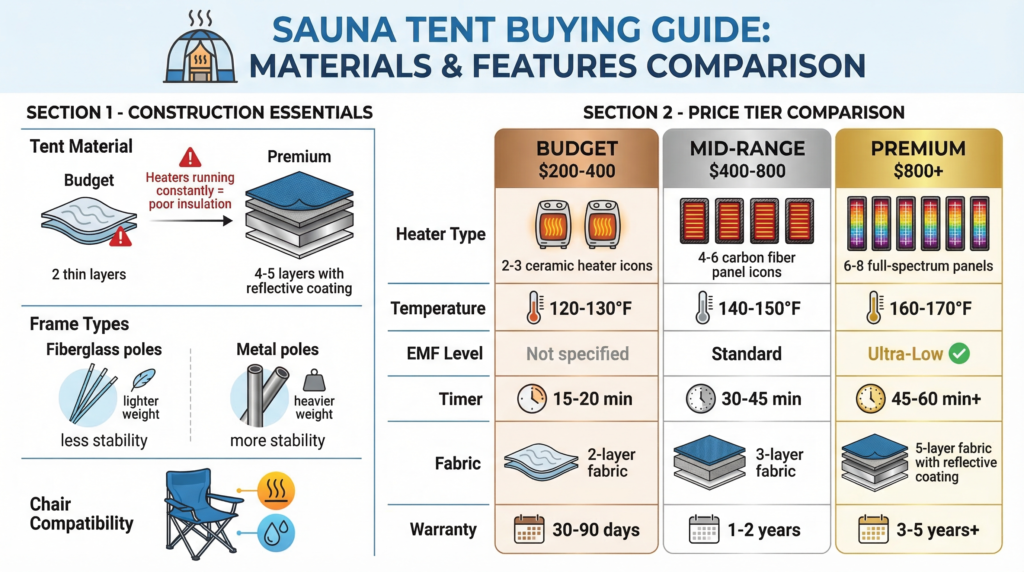
| Feature | Budget Models | Mid-Range | Premium |
|---|---|---|---|
| Heating Panels | 2-3 ceramic heaters | 4-6 carbon fiber panels | 6-8 full spectrum panels |
| Max Temperature | 120-130°F | 140-150°F | 150-160°F |
| EMF Level | Usually not specified | Under 10 mG claimed | Under 3-5 mG with testing |
| Heat-Up Time | 15-20 minutes | 10-15 minutes | 5-10 minutes |
| Material Layers | 2 layers | 3 layers with insulation | 4-5 layers, reflective coating |
| Warranty | 30-90 days | 1 year | 1-3 years |
Power Consumption
Most portable units run on standard 110V household outlets. They pull anywhere from 800-1500 watts.
To put that in perspective, that’s about the same as a space heater or hairdryer. So your electric bill will go up a bit if you’re using it regularly, but it’s not gonna be crazy expensive.
Some people worry about tripping breakers. If you’ve got other high-draw appliances on the same circuit, yeah, that could be an issue.
Just something to keep in mind.
Step-by-Step Guide to Choosing Your Unit
Step 1: Set Your Budget Range
Be realistic about what you’re willing to spend. The $200-300 units exist and they work (kinda), but they have limitations.
If you can swing $500-800, you’ll get a much better experience with faster heating, better insulation, and more reliable temperature control.
Above $1,000 you’re getting into premium territory with full spectrum heaters, super low EMF claims, thicker materials, and longer warranties.
Step 2: Measure Your Available Space
Grab a tape measure and actually measure where you plan to put this thing. Don’t just eyeball it.
Remember you need clearance around it for ventilation and safety. Most manufacturers recommend at least 6 inches of space on all sides.
Also think about access to outlets. Extension cords aren’t recommended for these units because of the power draw, so you want to be near a wall outlet.
Step 3: Identify Your Priorities
What matters most to you? Getting to temperature fast?
Super low EMF?
Easy storage? Color options?
(yeah, they come in different colors now)
Make a list of your top 3 must-haves and use that to narrow down options. You can’t have everything unless you’re dropping $1,500+, so prioritize.
Step 4: Research Specific Brands and Models
Once you know your budget and priorities, start looking at actual products. Read reviews on many sites, not just Amazon (where reviews can be… questionable).
Look for consistent complaints. If many people say a certain model doesn’t get hot enough or falls apart after 3 months, believe them.
Check the return policy too. Some brands offer 30-day money-back guarantees, others have restocking fees or only offer exchanges.
This matters when you’re buying something this size without trying it first.
Some popular brands to check out include SereneLife, Durherm, RadiantSaunas, and Higher DOse (though that your pricey). There are also a bunch of newer brands on Amazon that seem okay based on reviews but don’t have long track records yet.
Step 5: Check What’s Included
Does it come with a chair? A footpad?
A remote control?
Towels? A carrying case?
Some “complete kits” (aka portable infrared sauna kits) have everything you need. Others are bare bones and you’ll need to buy accessories separately, which adds to the total cost.
The listing should clearly state what’s in the box. If it doesn’t, that’s a red flag imo.
Step 6: Verify Specs and Certifications
Look for actual specifications, not just marketing language. What’s the wattage?
How many heating panels?
What’s the temperature range?
Certifications like ETL or CE show the unit has been tested for electrical safety. Not all portable saunas have these, but it’s a good sign when they do.
Expert Tips for Getting the Most Value
Don’t Skimp on the Basics
Getting a cheaper model that barely reaches 120°F is gonna be frustrating. You’ll be sitting in there for 45 minutes waiting to sweat, and it might not even happen.
Better to save up another month or two and get a mid-range unit that actually performs well. The difference between a $250 and $500 unit is honestly pretty significant in terms of heat output and build quality.
Consider Pre-Heating Time
Some people forget about this. If your unit takes 20 minutes to heat up, you need to factor that into your routine.
Faster heating units (usually ones with carbon panels) can be ready in under 10 minutes. That makes it way easier to actually use regularly instead of it becoming a hassle.
Think About Maintenance
These units need to be wiped down after use because sweat. Some materials are easier to clean than others.
Look for units where the interior is easy to access and wipe down. Some have removable floor mats which is super convenient for cleaning.
You’ll also want to let it air out after each session before folding it up. Mildew is a thing if you don’t.
Setup and Breakdown Reality Check
Brands claim “sets up in 5 minutes!” and technically that might be true… after you’ve done it 10 times and know exactly what goes where.
First time setup is gonna take longer. Just plan for 15-20 minutes the first time you put it together.
Same with breakdown and storage. If you’re planning to fold it up after every use, make sure you’re actually willing to do that.
Some people just leave theirs set up in a corner because it becomes annoying to keep assembling/disassembling.
Read the Fine Print on Warranties
A 1-year warranty sounds good until you realize it only covers the heating elements and not the tent material or frame.
Or that you have to pay shipping both ways if something breaks, which can be like $50-100 for something this big.
Some companies have great customer service and will help you troubleshoot issues. Others ghost you after the sale.
Check reviews specifically mentioning customer service experiences.
If you’re ready to start comparing specific models, looking at detailed specs from different brands can help you see what features actually matter at different price points and what’s just marketing fluff.
Common Mistakes People Make
Buying Based Only on Price
The absolute cheapest option usually ends up being disappointing. The materials are thin, the heaters are weak, and it might literally fall apart after a few months of regular use.
But also, you don’t necessarily need the most expensive option either. There’s a sweet spot in the $500-800 range where you get good quality without paying extra for bells and whistles you might not need.
Ignoring Size Specifications
“One size fits all” is not really true with portable infrared sauna kits. If you’re over 6 feet tall or over 250 lbs, some models are gonna be cramped and uncomfortable.
Check the interior dimensions and weight capacity. Some brands make XL versions for taller or larger guys.
Not Considering Power Requirements
Plugging this into a power strip with a bunch of other stuff is asking for trouble. These things draw serious power.
Also, if you’re in an older building with older wiring, you might have issues. Just something to be aware of before you order.
Expecting Instant Results
These units need to heat up before you get in. And you need to use them consistently to potentially see benefits.
Getting frustrated after one session because you didn’t have some dramatic experience is premature. Give it at least a few weeks of regular use (most people do 3-4 times per week) before deciding if it’s working for you.
Not Reading Return Policies Before Ordering
Some companies make returns difficult on purpose. Restocking fees, you pay return shipping, must be in original packaging (which you probably threw out), etc.
Know what you’re getting into before you click buy. Screenshot the return policy if you need to.
Forgetting About Electricity Costs
Running this thing for 45 minutes to an hour several times a week will show up on your electric bill.
It’s not gonna be crazy expensive (probably $10-20/month depending on usage and rates), but if you’re on a super tight budget, factor that in.
Brands and Budget Breakdown
Some links may be affiliate links, meaning this site may earn commissions on purchases at no additional cost to you.
Budget-Friendly Options
These work okay for occasional use. The materials are thinner, heating is slower, and they might not last as long.
SereneLife and Durherm both have options in this range that get decent reviews. They’re fine for trying out the whole sauna thing without a huge investment.
Just manage expectations. You’re not getting premium performance at this price point.
Mid-Range Sweet Spot
This is where I’d recommend most people shop. You get carbon fiber heating panels, better insulation, faster heat-up times, and better build quality.
Brands like Durasage sit here. The difference in performance compared to budget models is really noticeable based on user reviews.
Warranties are usually better too, around 1 year for parts.
Premium Options
Higher DOse makes a popular model in this range (the Infrared Sauna Blanket is different but same brand makes a tent style too). Therasage and Sunlighten and SunHome Saunas also have premium portable options.
You’re paying for full spectrum infrared, ultra-low EMF tech, thicker materials, faster heating, and longer warranties. Plus the brands usually have better customer service.
If you’ve got the budget and plan to use it regularly for years, the premium options make sense. For casual use, they’re probably overkill.
When you’re looking at different price ranges, checking out many options side-by-side helps you see what features jump between budget tiers and where you get the most value for your specific situation.
Watch for Sales and Bundles
Black Friday and Amazon Prime Day usually have deals on these. You can sometimes get a mid-range unit for budget prices.
Also look for bundle deals that include accessories like the chair, towels, and carrying case. That can save you $50-100 vs buying everything separately.
Making Your Final Decision
So after all this, how do you actually choose?
Start with your hard limits. Budget, space, and must-have features.
That’ll eliminate like 70% of options right away.
Then narrow it down to 2-3 specific models and really compare the details. Read reviews for those specific models, not just general brand reviews.
Look at the warranty and return policy one more time. Make sure you’re comfortable with the terms.
And honestly, at some point you just gotta pick one and try it. Analysis paralysis is real with purchases like this because there are so many options.
Most decent units in the $500+ range are gonna perform pretty similarly. You’re not gonna ruin your life by picking model A instead of model B.
If you’ve narrowed it down to a couple solid options and you’re ready to make a purchase, going with a brand that has good customer service reviews and a solid return policy gives you peace of mind while you test it out in your own space.
Real Talk About Expectations
These portable saunas aren’t the same as a $10,000 wooden cabin sauna. They’re just not.
But for the price and convenience factor, they offer a pretty good compromise. You can set one up in your bedroom or bathroom, use it regularly without a huge lifestyle change, and take it with you if you move.
The temperature won’t get quite as high as traditional saunas. The space is smaller and more enclosed. You might need to wipe down condensation from the inside.
But you also didn’t spend five figures and you didn’t need to hire contractors. Trade-offs.
The important thing is getting a unit that actually reaches therapeutic temperatures (at least 140°F), has decent insulation so it maintains that heat, and is comfortable enough that you’ll actually use it regularly.
Everything else is just details.
Wrapping This Up
Choosing a portable infrared sauna comes down to balancing your budget, your space, and what features actually matter to you.
Don’t get distracted by marketing hype about new technology or secret claims. Focus on the basics: heating power, temperature range, build quality, and warranty.
Read real user reviews from people who’ve had the unit for at least a few months. Early reviews are often overly positive because everything works when it’s brand new.
And remember that the best sauna is the one you’ll actually use. If a $400 model fits your budget and your life better than a $1,200 model, go with the $400 one.
Consistency matters way more than having the absolute top-of-the-line unit sitting unused in your closet.
Ready to set up your own at-home sauna situation? Taking the time to compare a few quality options in your budget range means you’ll end up with something that actually works for your space and routine instead of becoming an expensive thing you’re stuck with.
The whole point of going portable is making wellness stuff more accessible and convenient. Don’t overthink it to the point where you never actually buy one.
Pick a solid mid-range option from a brand with good reviews and a return policy you’re comfortable with. Set it up, try it out, and adjust from there.
You’ve got this.
Still Need More Information Then You Might Want to Read These Articles:
- Are Portable Infrared Sauna Kits Worthwhile? Pros, Cons, and Key Considerations
- Top 5 Portable Infrared Sauna Kits for Home Use in 2026
- Solstice Portable Infrared Sauna vs Equinox 2-Person Portable Sauna: Which is Better?
- SLISAU35BK Portable Steam Home Spa vs Full Size Portable Infrared Sauna?
- Portable Infrared Sauna Kits (2026): Sun Home Saunas vs. Radiant Health Saunas
- Best Infrared Sauna Blankets: Reviews & Comparison (2026)
- Portable Infrared Sauna for Home: Best Compact & Lightweight Options for Small Spaces (2026)
- Comparing Budget vs. Premium Portable Infrared Sauna Kits: What You Get
- Best Infrared Sauna Blanket for Detox (2026): Top Picks for Home Use
- Best Low EMF Sauna Blanket (2026): Safe Picks That Actually Work
- Sauna Accessories
- Portable Infrared Sauna Kits: Complete Buyer’s Guide (2026)
This guide provides educational information for selecting portable infrared sauna kits. Some links may be affiliate links, meaning this site may earn commissions on purchases at no additional cost to you.
Disclaimer: The wellness benefits described are based on general research and user experiences. Individual results may vary as these are only opinions. Consult with a healthcare professional before beginning any new wellness routine, especially if you have pre-existing medical conditions, are pregnant, or take medications. Infrared sauna use is not intended to diagnose, treat, cure, or prevent any disease.