Table of Contents
Introduction
Radiant Health keeps popping up when people talk about home infrared saunas. You’ll see the brand mentioned on Reddit sauna threads, Amazon reviews, wellness forums… basically anywhere people talk about this stuff.
The thing is, most of these mentions aren’t from sponsored posts or affiliate pushers. They’re from people who actually bought one and decided to share their experience online.
When you’re looking at a radiant saunas review, the main questions usually come down to practical stuff. Does the sauna actually heat evenly, or will your back be roasting while your legs stay cold?
Are the EMF safety claims legitimate or just marketing BS?
Will it fit in your apartment? And honestly, does the price tag make any sense when you can grab a cheaper sauna for half the cost?
Those are the questions that matter when you’re about to drop a few thousand dollars on something that takes up floor space in your home.
This guide provides educational information for selecting portable infrared sauna kits. Some links may be affiliate links, meaning this site may earn commissions on purchases at no additional cost to you.
Features Overview
Radiant Health makes both smaller units (like the 2-person Pause) and bigger setups (the E2.5H and larger models). The engineering approach stays pretty consistent across their lineup.
1)How the Heaters Are Set Up
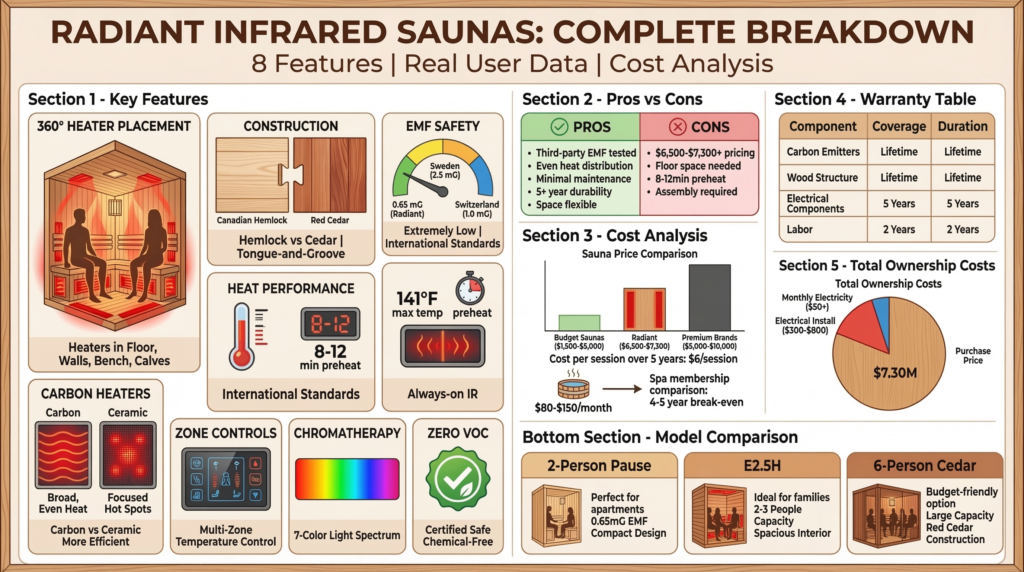
The main thing Radiant does differently is how many heaters they pack in and where they put them. The E2.5H has heaters in the floor, along all the walls, built into the bench, and even targeting your calves specifically.
Instead of slapping a few panels on the walls and calling it done, Radiant spreads the heat sources around. You get heating panels below where you sit, surround heaters on the sides, and front wall heaters working together.
This actually matters. A lot of saunas concentrate their heat sources in just a few spots, which means you end up warm on one side and cold on the other.
You spend half the session shifting around trying to get comfortable.
Radiant’s setup handles this through the actual design as opposed to making you play musical chairs with yourself.
2) What It’s Built From
Radiant uses either Canadian hemlock or red cedar depending on which model you’re looking at. Cedar smells good when it heats up and naturally resists rot, which matters since you’re dealing with humidity and sweat.
Hemlock does similar stuff with slightly different characteristics.
The panels connect using tongue-and-groove construction, which means the wood pieces lock together instead of just being screwed or nailed side-by-side. This cuts down on gaps where heat can escape and keeps the thing from creaking as much when the wood expands and contracts (which all wood does).
3) EMF Safety Stuff
This is where Radiant actually separates itself from competitors. The Pause model shows ultra-low EMF readings averaging 0.65 mG, and they had a third party test this at over 25 different points inside the sauna.
For context, Sweden recommends keeping it under 2.5 mG for prolonged exposure. Switzerland suggests staying below 1 mG as a precautionary measure.
Radiant’s numbers fall below both of those guidelines. They also test for electric field levels and VOCs (volatile organic compounds), with verified zero VOC certification.
The electronics sit beneath the bench instead of right next to where you’re sitting, which lowers your EMF exposure during actual use.
The third-party verification part matters here. Any company can say “low EMF” on their website.
Actually publishing the measured values at the exact spots where your body will be sitting… that’s different.
4) Controls and Convenience Stuff
The EZ-Touch dual control panels let you adjust temperature from inside or outside the sauna. You don’t have to interrupt your session to change settings.
Individual zone controls let you customize heat to different areas independently. You can have the bench top warmer, the calf area cooler, floor somewhere in between… whatever works for you.
Some models connect to a mobile app so you can pre-heat from your phone. Others stick with manual timers and skip the screens entirely, which some people prefer since it removes distractions.
It depends on whether you want convenience features or simplicity.
5) Chromatherapy and Audio
Most Radiant models include 7-color chromatherapy lighting (basically colored light therapy). There’s also CD and MP3 connectivity for audio, which makes sense since sessions typically run 30-45 minutes and sitting in silence might not be your thing.
These aren’t core features, but they affect the overall experience.
Performance Analysis
6) Heat Output and Consistency
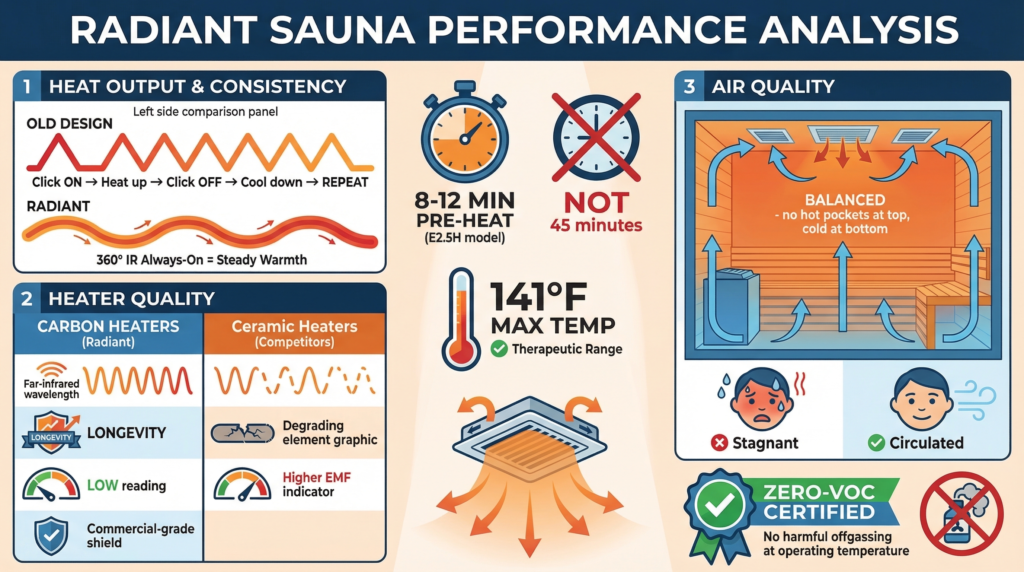
The heater layout translates to actual performance differences. Thermal imaging tests show Radiant models achieving consistent heat distribution without the on-off cycling that older sauna designs use.
The “always-on 360° IR” approach gives you steady warmth instead of the sauna clicking on, heating up, clicking off, cooling down, repeat. Some people find that cycling super distracting.
Pre-heat time varies by model size. The E2.5H reaches operational temperature for sweating in about 8-12 minutes when you pre-heat it.
Smaller models heat up faster.
This matters if you’re trying to use the sauna before work or after a workout. Waiting 45 minutes for it to heat up defeats the whole purpose.
Maximum temperature hits around 141°F on various models, which is sufficient for therapeutic sauna use. The adjustable ceiling vent let’s you control heat intensity without messing with the thermostat.
7) Heater Quality
Radiant exclusively uses carbon heaters as opposed to ceramic. Carbon heaters emit far-infrared wavelengths more consistently and tend to last longer.
They also produce lower EMF readings than some ceramic alternatives, partly because of the materials involved.
Heater quality affects durability. Cheaper saunas use thin ceramic elements that degrade over time.
Radiant’s commercial-grade carbon heaters handle repeated heating cycles over years without significant performance drops.
8) Air Quality
The engineered air channels balance temperature from floor to ceiling, preventing those annoying hot pockets near the ceiling while your feet stay cold at floor level.
This affects both comfort and whether each session actually works the way it’s supposed to.
Stagnant air feels stifling. Circulated air feels more natural.
The zero-VOC certification means the sauna environment won’t offgas harmful chemicals even at operating temperature. Many wooden saunas release volatile organic compounds when heated (you can smell it, that chemical smell).
Radiant’s third-party verification eliminates this concern.
Pros and Cons
What Works Well
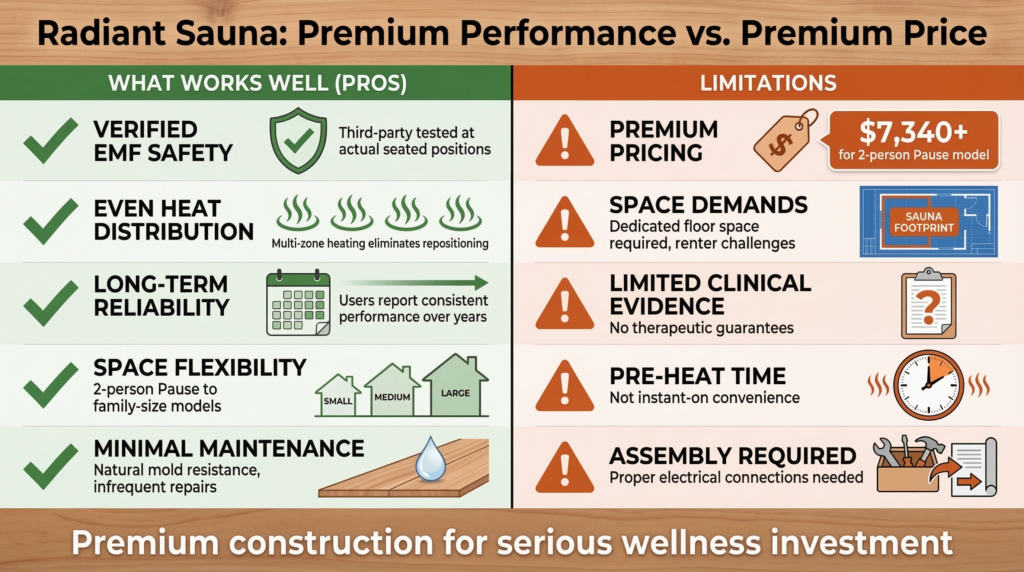
- Verified EMF safety, Third-party testing at the actual seated positions provides confidence as opposed to just marketing claims. For people genuinely concerned about electromagnetic field exposure, this removes a major decision barrier.
- Even heat distribution, The multi-zone heating approach eliminates the constant adjusting and repositioning that happens with single-source heaters.
- Consistent performance over time, People across many platforms report that Radiant models maintain performance over years, which suggests the build quality actually delivers long-term value.
- Flexibility for different spaces, The 2-person Pause works in apartments and small homes. Larger models accommodate families or social use.
- Minimal maintenance, Cedar and hemlock resist mold naturally. Construction quality means repairs are infrequent compared to budget choices.
Where Limitations Exist
- Price point, Radiant models cost considerably more than budget infrared saunas. A Pause 2-person model starts around $7340, with larger configurations costing much more. This positions them as premium products, not entry-level purchases.
- Space requirements, Even 2-person models need dedicated floor space. Renters may face installation challenges with landlords who aren’t thrilled about it.
- No established health claims research, While many people report feeling better after sauna use, clinical evidence linking specific saunas to measurable health outcomes stays limited. The company appropriately makes no therapeutic guarantees.
- Longer initial heat time than smallest portable units, Though fast by sauna standards, the 8-12 minute pre-heat time may frustrate people expecting instant-on convenience.
- Assembly complexity, These aren’t plug-and-play devices. Assembly needs space and attention to proper electrical connections.
User Experience
What People Actually Say
Across Reddit sauna communities, YouTube reviews, and sauna-specific forums, some recurring themes emerge about Radiant models.
- Heat quality consistency, Multiple reviewers specifically mention that Radiant performs better than other saunas at similar price points when tested with thermal imaging equipment. This suggests the heater layout engineering actually works as advertised.
- Confidence in EMF claims, People specifically appreciate the third-party EMF testing reports. For those with EMF sensitivity concerns, the published data eliminates guesswork.
- Whether EMF represents a real health risk stays debated among scientists, but the uncertainty itself drives purchasing decisions. Having actual numbers helps.
- Session comfort, People report achieving comfortable sweating sessions without excessive head-level heat that characterizes poorly designed units. The floor heating and distributed approach seems to prevent the “head’s cooking, feet are cold” problem common elsewhere.
- Space adaptation, Both apartment dwellers and homeowners report successfully integrating Radiant saunas without major renovations. The pre-fabricated construction avoids the custom-build requirements of larger installations.
- Lack of regret posts, A notable absence on forums is buyers expressing buyer’s remorse. This doesn’t mean everyone loves their Radiant sauna, but satisfaction rates appear higher than budget choices based on discussion patterns.
Value for Money
Cost-to-Performance Calculation
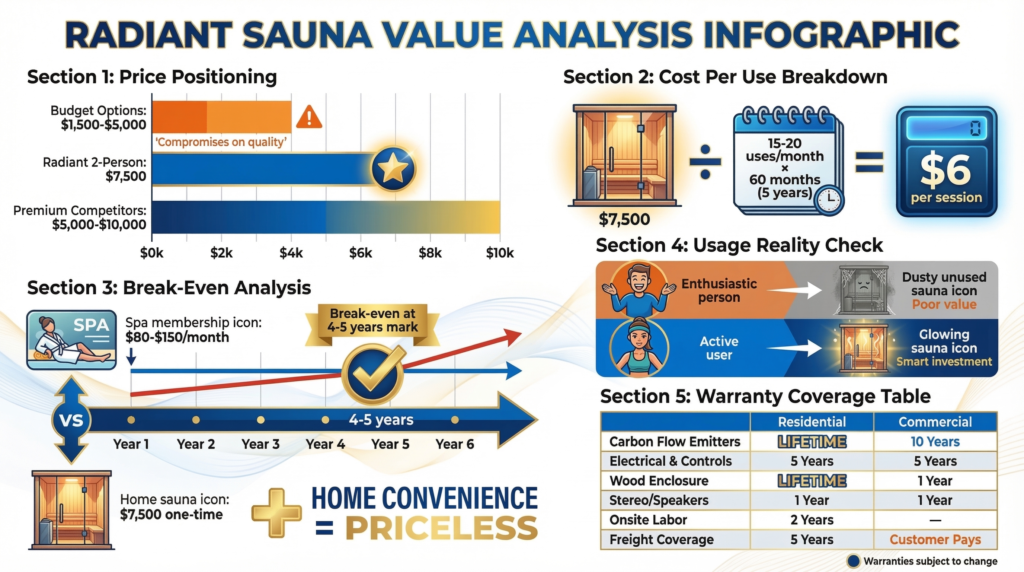
A 1 person is $6500 and Radiant 2-person sauna costs roughly $7300. Comparable saunas from other premium brands run $5,000-10,000 so its definitely in the premium category.
Budget options cost $1,500-$5000 but often compromise on heater distribution, material quality, or EMF testing.
If you plan on using it 15-20 times monthly for 5+ years (the typical ownership horizon before needing major repairs or replacement), your cost per session approaches $6.
A monthly spa membership with sauna access costs $80-150. The break-even point would be somewhere around 4-5 years but you have to figure in the convenience factor of it being at home and not at a gym…..That’s priceless!
Saunas purchased with enthusiasm that sit unused for months represent poor value at any price.
Honest self-assessment about whether you’ll actually use the thing determines whether the investment makes financial sense.
Warranty Coverage
| Component | Residential | Commercial |
|---|---|---|
| Carbon Flow Emitters | Lifetime | 10 Years |
| Electrical & Controls | 5 Years | 5 Years |
| Wood Enclosure | Lifetime | 1 Year |
| Stereo / Speakers | 1 Year | 1 Year |
| Onsite Labor | 2 Years | — |
| Freight Coverage | 5 Years | Customer pays |
Warranties are subject to change at the will of the company but just looking at them Radiant Saunas has a great warranty.
Total Cost of Ownership
Beyond the sauna itself, factor in a few things.
Electrical installation, Most models need dedicated 15-20 amp circuits. If your home lacks appropriate outlets in the sauna location, expect $300-800 for an electrician to run new wiring.
Maintenance, Periodic wood cleaning and occasional silicone sealant replacement cost minimal money but need attention.
Electricity costs, Running a sauna 3-4 times weekly costs roughly >$50 monthly depending on your local energy rates and model size.
These costs stay modest compared to the initial purchase, but they’re worth calculating upfront.
Final Verdict
Radiant Health saunas represent engineering-focused manufacturing in the infrared sauna category. They emphasize measurable performance (heater distribution, EMF levels, heat consistency) over marketing hype.
Third-party EMF testing at actual seating positions addresses a legitimate concern that many competitors either ignore or handle superficially.
The price premium reflects actual construction quality, material selection, and testing investments. Whether that premium justifies the cost depends on your specific situation.
The sauna works best for people who will use it regularly (2+ times weekly), care about EMF safety with verified data, have dedicated space available, and view the sauna as a 5+ year investment as opposed to a trend purchase.
You might want to reconsider if you’re budget-constrained, uncertain about consistent usage patterns, or lack suitable installation space. A cheaper model may satisfy your needs adequately in those cases.
The core reality is this: Radiant saunas perform as advertised. Heat distribution actually works. EMF levels actually are low.
Materials actually last.
You’re paying for engineering competence, not a marketing premium.
Where to Buy
If you’re moving forward with a Radiant purchase, model selection depends on your specific situation.
The Radiant 2-Person Pause Sauna works best for apartments and couples. The ultra-low 0.65 mG EMF reading suits people concerned about electromagnetic fields.
Pre-heats quickly and fits standard home spaces without requiring major renovations.
The Radiant E2.5H larger model works best for families or social use. Accommodates 2-3 people comfortably with the most comprehensive heater coverage.
Heats faster than you’d expect given the size.
If budget is the primary concern, the Radiant 6–person cedar model offers carbon heaters and cedar construction at a lower price point, though with less comprehensive third-party EMF documentation.
Before purchasing any sauna, verify your electrical capacity with a licensed electrician. Verify your space dimensions twice (saunas are hard to return once assembled).
Review the warranty details specific to your model.
The decision to invest in a home sauna represents a commitment to consistent wellness practice. Radiant builds products that support that commitment through reliable performance, not empty promises.
When you’re evaluating a radiant saunas review like this one, the practical considerations matter most. The engineering works.
The materials last.
The price reflects actual value as opposed to marketing fluff.
The rest depends on whether you’ll actually use it.
This guide provides educational information for selecting portable infrared sauna kits. Some links may be affiliate links, meaning this site may earn commissions on purchases at no additional cost to you.
Disclaimer: The wellness benefits described are based on general research and user experiences. Individual results may vary as these are only opinions. Consult with a healthcare professional before beginning any new wellness routine, especially if you have pre-existing medical conditions, are pregnant, or take medications. Infrared sauna use is not intended to diagnose, treat, cure, or prevent any disease.