Table of Contents
Introduction
You’re sitting in your 800-square-foot apartment, scrolling through portable infrared sauna kits for the fourth time this month.
The math makes sense: $40 per infrared sauna session at the wellness center down the street adds up to $480 monthly. Meanwhile, a one-time purchase could deliver unlimited sessions for less than the cost of three months’ membership.
But the reviews are mixed. Some people rave about life-changing results. Others complain about flimsy construction and disappointing heat levels.
Some links are affiliate links, meaning this site may earn commissions on purchases at no additional cost to you.
Durasage sits in that confusing middle zone—affordable enough to feel accessible, but expensive enough that buyer’s remorse would sting. This comprehensive Durasage portable sauna kit review examines specifications, performance data, and realistic expectations to help you determine if this portable sauna kit deserves your money and limited living space.
What Is the Durasage Portable Sauna Kit?
Durasage manufactures tent-style portable infrared saunas designed for budget-conscious consumers seeking at-home heat therapy without permanent installation.
Unlike cabin-style wooden saunas that require assembly and significant floor space, Durasage uses a pop-up tent design that deploys in minutes and stores in a carrying case when not in use.
Product Configuration
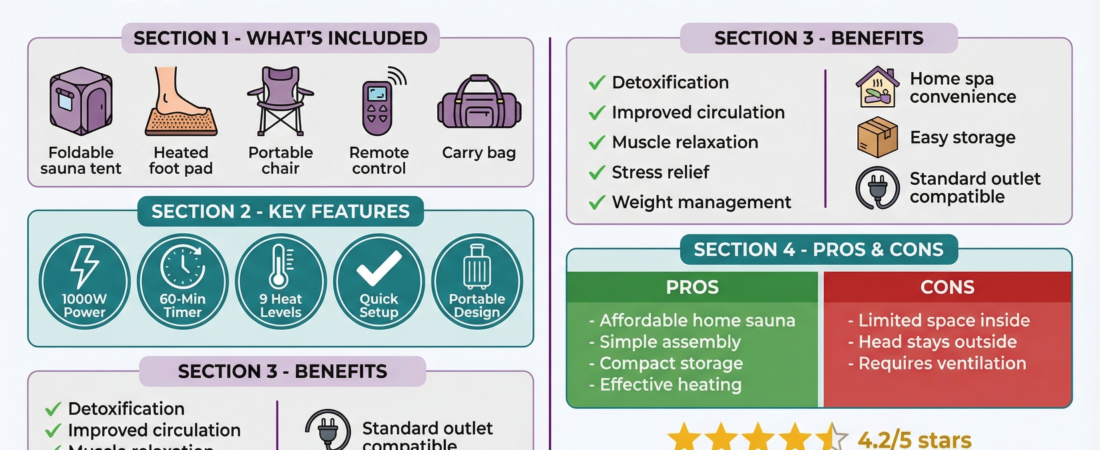
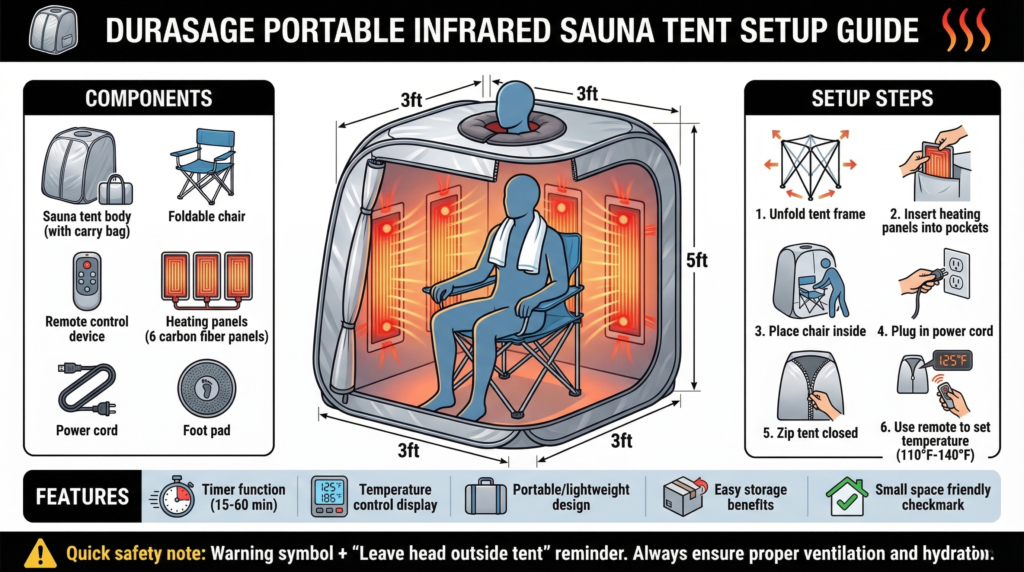
The standard Durasage kit includes:
- Pop-up fabric tent enclosure: 33″ x 28″ x 36″ (varies by model)
- Collapsible chair frame: Provides seating inside the tent
- Infrared heating foot pad: Primary heat source (1000-1500W)
- Handheld remote control: Temperature and timer adjustment
- Carrying case: For storage and portability
Design philosophy: Head-out configuration allows users to sit inside the heated enclosure while their head remains outside for easier breathing and temperature regulation. This differs from full-cabin designs that enclose the entire body including the head.
Check Current Durasage Pricing on Amazon
Durasage Features Overview: What’s Included
Understanding specific components helps set realistic performance expectations.
Tent Construction Specifications
| Component | Durasage Specification | Quality Assessment |
| Outer fabric | Polyester with waterproof coating | Standard for tent-style units |
| Inner lining | Reflective thermal material | Redirects heat inward |
| Insulation thickness | Single layer (~3mm) | Minimal compared to cabin units |
| Zipper quality | Heavy-duty with double pull | Adequate for frequent use |
| Tent poles | Fiberglass flexible rods | Lightweight but prone to stress fractures |
| Window panel | Clear vinyl with zipper closure | Allows visibility and arm access |
Construction reality: The tent design prioritizes portability over insulation. Single-layer fabric with reflective lining provides adequate heat retention for the power output but cannot match the thermal efficiency of dual-wall cabin saunas.
Fiberglass poles flex easily for quick setup but represent the most common failure point according to consumer reports. Stress from repeated folding/unfolding can cause fractures after 6-12 months of regular use.
Heating System Breakdown
| Specification | Durasage Range | Performance Context |
| Heating technology | Carbon fiber infrared panels | Industry-standard technology |
| Primary heat source | Foot pad (9-panel configuration) | Bottom-up heating distribution |
| Power consumption | 1000-1500 watts | Similar to space heater |
| Maximum temperature | 140-150°F (claimed) | Upper end of portable sauna range |
| Heat-up time | 15-25 minutes | Faster than cabin-style units |
| Temperature range | 90-150°F | Adjustable via remote control |
| Timer function | 15-60 minutes | Programmable session length |
Heating mechanism explained: Unlike cabin saunas with wall-mounted panels providing 360-degree heat, Durasage’s foot pad generates heat that rises through the enclosed tent space. The reflective interior lining redirects infrared waves toward the body.
This bottom-up approach creates temperature gradients—feet and lower body experience higher temperatures while upper body and shoulders receive less direct heat exposure.
Size and Space Requirements
Assembled dimensions:
- Footprint: 33″ x 28″ (approximately 6.4 square feet)
- Height: 36″ (allows seated position with head outside)
- Interior space: Accommodates single person up to 6’2″ and 250 pounds
Storage dimensions:
- Collapsed in carrying case: 30″ x 8″ x 8″
- Weight: 18-22 pounds
- Storage space required: Equivalent to medium duffle bag
Space analysis: Assembled footprint smaller than most coffee tables makes this one of the most space-efficient sauna options available. The 36-inch height accommodates most users in standard seated position but may feel cramped for taller individuals (6’3″+).
Performance Analysis: Heat, Coverage, and Efficiency
Specifications on paper differ from real-world thermal performance. Understanding these dynamics prevents disappointment.
Temperature Performance Data
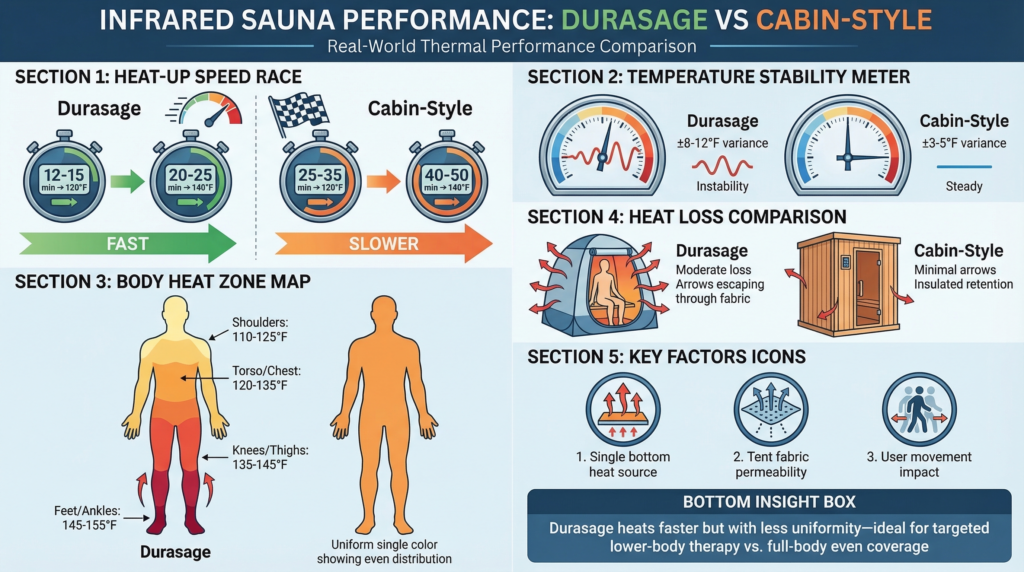
| Metric | Durasage Performance | Cabin-Style Comparison |
| Heat-up to 120°F | 12-15 minutes | 25-35 minutes |
| Heat-up to 140°F | 20-25 minutes | 40-50 minutes |
| Temperature stability | ±8-12°F variance | ±3-5°F variance |
| Heat distribution | Concentrated at lower body | More uniform coverage |
| Ambient heat loss | Moderate (single-layer tent) | Minimal (insulated walls) |
Performance interpretation: Durasage heats significantly faster than cabin-style units due to smaller enclosed volume and single heating source requiring less total energy. However, temperature consistency varies more widely because:
- Tent fabric allows more heat escape than rigid insulated walls
- Single bottom-mounted heat source creates vertical temperature gradient
- User movement and position shifts affect heating patterns
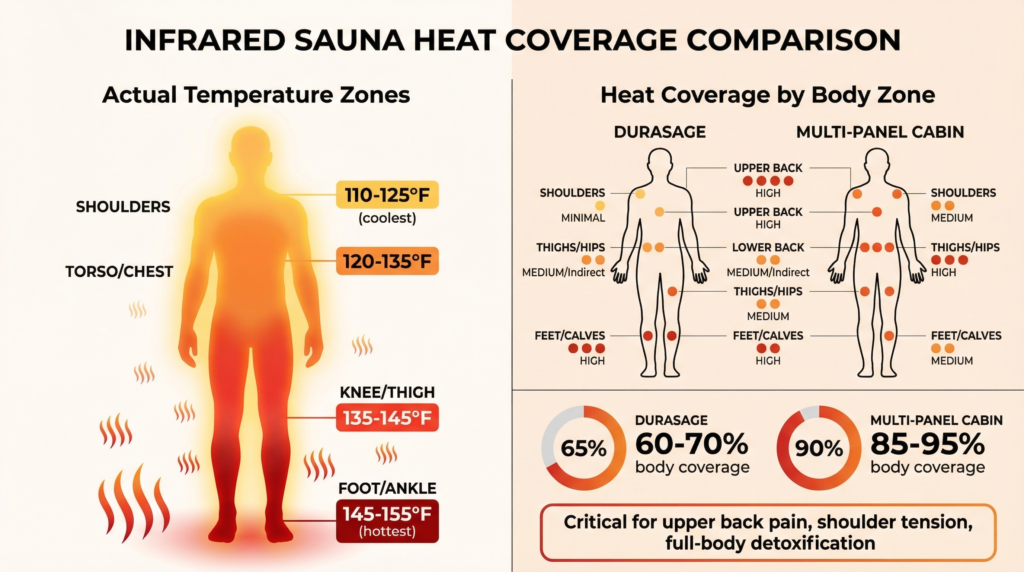
Actual temperature zones reported:
- Foot/ankle area: 145-155°F (direct pad contact)
- Knee/thigh area: 135-145°F
- Torso/chest area: 120-135°F
- Shoulder area: 110-125°F
Users seeking uniform full-body heat exposure may find this gradient disappointing compared to cabin units with multi-panel coverage.
Heat Coverage Comparison
| Body Zone | Durasage Coverage | Multi-Panel Cabin Coverage |
| Feet/calves | Direct exposure (high intensity) | Direct exposure (medium intensity) |
| Thighs/hips | Indirect infrared (medium) | Direct exposure (high intensity) |
| Lower back | Indirect infrared (medium) | Direct exposure (high intensity) |
| Upper back | Minimal exposure (low) | Direct exposure (high intensity) |
| Shoulders | Minimal exposure (low) | Direct exposure (medium intensity) |
Coverage assessment: Approximately 60-70% of body surface receives meaningful infrared exposure in Durasage configuration versus 85-95% in cabin-style units with wall-mounted panels.
This matters significantly for users seeking therapeutic benefits for upper back pain, shoulder tension, or full-body detoxification protocols.
EMF Safety: Critical Health Considerations
EMF (electromagnetic field) exposure concerns are particularly relevant for portable infrared sauna kits that position heating elements in direct contact with users’ bodies.
Durasage EMF Testing Results
Manufacturer states it has the lowest EMF/EMR ratings compared to rival infrared saunas.
Slim carbon fiber heating panels aimed at reducing electromagnetic field exposure
Three low-EMF heating elements strategically located around your body
Pros and Cons: Balanced Assessment
Every portable sauna involves trade-offs between portability, performance, and price.
Documented Advantages
1. Exceptional portability and storage Collapses to carrying case equivalent to medium duffle bag. This represents the most compact storage option among portable infrared sauna kits. Apartment dwellers can store under beds, in closets, or behind furniture—impossible with cabin-style units.
2. Rapid deployment Setup time averages 3-5 minutes after initial familiarization. Pop-up tent design requires no tools, no assembly instructions, and minimal effort. Users can transition from storage to ready-for-use faster than cabin units heat up from room temperature.
3. Aggressive pricing around $500 depending on sales and model variations, Durasage costs 60-75% less than cabin-style alternatives. This pricing makes home infrared therapy accessible to budget-conscious consumers testing the wellness practice before larger investments.
4. Energy efficiency Lower power consumption (1000-1500W) plus faster heat-up times reduce electricity costs by approximately $120-170 annually compared to cabin units. This efficiency compounds over multi-year ownership.
5. Easy cleaning and maintenance Tent fabric wipes clean with damp cloth. No wood to maintain, no panel connections to inspect, no structural components requiring adjustment. Maintenance takes 2-3 minutes per session.
Documented Limitations
1. EMF exposure Manufacturer states it has the lowest EMF/EMR ratings compared to rival infrared saunas.
2. Uneven heat distribution Bottom-up heating from single source creates 25-40 degree temperature difference between feet and shoulders. Users seeking uniform therapeutic heat for upper body conditions find this inadequate.
3. Limited upper body coverage Shoulders, upper back, and neck receive minimal direct infrared exposure. This matters substantially for individuals with upper body chronic pain, tension, or recovery needs.
4. Durability concerns Tent poles reportedly crack or fracture after 6-12 months of regular use. Fabric zippers show wear after 8-10 months. Expected lifespan of 18-24 months falls short of cabin units lasting 3-5 years.
5. Head-out design limitations While easier for breathing, head-out configuration prevents whole-body thermal experience. Users cannot achieve full immersion in heated environment—a specific therapeutic goal for some protocols.
6. Less professional aesthetic Tent-style appearance lacks the premium feel of wooden cabin units. This matters for users viewing sauna as home spa element or who entertain guests in living spaces.
User Experience: Practical Daily Use
Understanding routine use patterns reveals whether convenience advantages offset performance limitations.
Setup Process Analysis
| Step | Time Required | Difficulty Level | Notes |
| Remove from carrying case | 30 seconds | Very easy | Case unzips simply |
| Deploy tent frame | 60-90 seconds | Easy | Pop-up mechanism self-expands |
| Position chair inside | 30 seconds | Very easy | Lightweight folding design |
| Place foot pad | 20 seconds | Very easy | Connects via standard plug |
| Connect remote control | 10 seconds | Very easy | Plugs into foot pad unit |
| Close and zip tent | 30 seconds | Easy | Ensure complete seal |
| Total setup time | 3-4 minutes | Easy | Significantly faster than cabin units |
First-time setup: Initial deployment may take 5-8 minutes as users familiarize themselves with tent expansion and chair positioning. By third setup, most users achieve 3-4 minute standard time.
Session Experience Factors
| Experience Element | Durasage Reality | Impact Assessment |
| Comfort during session | Adequate for 20-30 min, cramped for 45+ min | Medium limitation |
| Breathing ease | Excellent (head outside tent) | Significant advantage |
| Temperature control | Responsive remote adjustment | Positive feature |
| Mobility inside unit | Limited (seated position only) | Minor limitation |
| Noise level | Silent (no fans or mechanical parts) | Positive feature |
| Privacy level | Requires dedicated room or privacy screen | Depends on living situation |
Comfort optimization strategies:
- Use cushioned chair pad for extended sessions
- Position small fan near head for air circulation
- Keep water bottle, phone, and towel within arm’s reach
- Set timer to avoid overextending session length
- Position tent near wall for stability
Breakdown and Storage Process
| Step | Time Required | Notes |
| Power off and unplug | 15 seconds | Allow brief cool-down |
| Open tent and remove chair | 30 seconds | Wipe down chair if needed |
| Fold tent structure | 60-90 seconds | Collapse poles gently to prevent stress |
| Return foot pad and remote | 30 seconds | Cord management prevents tangling |
| Place in carrying case | 45 seconds | Ensure proper folding for case fit |
| Total breakdown time | 3-4 minutes | Quick return to storage |
Storage location considerations:
- Under bed (requires 31″ clearance)
- Bedroom closet floor or shelf
- Hall closet among other bags
- Behind couch or large furniture
The space flexibility represents Durasage’s strongest advantage over cabin alternatives requiring permanent 25-30 square foot footprints.
Value for Money: Investment Analysis
Understanding total ownership costs reveals whether upfront savings translate to genuine long-term value.
Purchase Price Positioning
Price positioning: Durasage competes directly with other tent-style units rather than cabin alternatives. Within its category, pricing falls mid-range—neither the absolute cheapest nor most expensive option.
Total Cost of Ownership (2-Year Analysis)
| Cost Component | Durasage | Budget Cabin | Mid-Tier Cabin |
| Initial purchase | around $500 | $1500 + | $4 to 5000+ |
| Electricity (Year 1) | $180 | $280 | $336 |
| Electricity (Year 2) | $180 | $280 | $336 |
| Replacement parts | $35 (tent poles) | $30 | $20 |
| 2-Year Total | $625 | $2,090 | $6000+ |
Savings calculation: Over two years, Durasage costs $1500 less than budget cabin units and thousands less than mid-tier alternatives.
However, lifespan considerations change the equation:
- Durasage expected life: 18-24 months
- Budget cabin life: 30-40 months
- Mid-tier cabin life: 48-60 months
Value insight: When accounting for lifespan, Durasage and cabin options deliver similar cost-per-month value. The decision hinges on performance needs, space constraints, and upfront budget availability rather than pure financial optimization.
Break-Even Scenarios
Scenario 1: Replacing Wellness Center Visits
Scenario 2: Adding New Wellness Practice
Check Current Durasage Deals and Discounts
Comparison to Other Portable Infrared Sauna Kits
Understanding competitive positioning clarifies Durasage’s specific niche within the broader market.
Tent-Style Competitor Analysis
| Brand/Model | Price | Key Differentiators | Best For |
| Durasage | $400-500 | Mid-range price, standard features | Budget-conscious buyers wanting reliable brand |
| SereneLife Pop-Up | $300 | Lowest price, basic construction | Absolute budget priority |
| Radiant Saunas Rejuvalight | ????? | Enhanced insulation, better poles | Quality-focused tent buyers |
Durasage positioning: Comparable in price and quality. Not the cheapest option but also not commanding premium for enhanced features. Represents “safe middle choice” for buyers wanting established brand without significant upcharge.
Tent-Style vs. Cabin-Style Decision Matrix
| Factor | Tent-Style (Durasage) Advantage | Cabin-Style Advantage |
| Portability | ✓✓✓ Stores in closet | ✗ Requires permanent space |
| Setup time | ✓✓ 3-5 minutes | ✗ 25-35 minutes |
| Upfront cost | ✓✓ $400-500 | ✗ $1500+ |
| Heat coverage | ✗ 60-70% body surface | ✓✓ 85-95% body surface |
| EMF levels | ✗ Low | ✓ Low |
| Durability | ✗ 18-24 months | ✓✓ 36-60 months |
| Upper body heat | ✗ Minimal exposure | ✓✓ Direct panel coverage |
| Professional appearance | ✗ Tent aesthetic | ✓✓ Wood cabin design |
Decision guideline: Choose tent-style (Durasage) if portability and storage flexibility outweigh performance and longevity concerns. Choose cabin-style if therapeutic optimization and multi-year durability justify higher cost and space commitment.
Final Verdict: Should You Buy Durasage?
Yes! The Durasage portable sauna kit succeeds as a specific solution for specific situations rather than a universal recommendation.
Overall Assessment Matrix
Ideal Buyer Profile
Buy Durasage if you:
- Have severe space constraints: Studio apartment, shared living situation, or zero dedicatable floor space
- Prioritize storage flexibility: Need sauna that disappears completely when not in use
- Focus on lower body therapy: Primary concerns include leg circulation, foot pain, or lower back issues
- Budget limited to $500: Cannot or prefer not to invest $1500 + in cabin alternatives
- Testing sauna therapy interest: Exploring whether regular sauna practice fits your lifestyle before larger investment
- Use frequency 2-4 times weekly: Adequate for moderate use but insufficient for daily protocols
Alternative Recommendations
Choose different options if you:
| Your Priority | Better Alternative | Reason |
| Upper body pain relief | Mid-tier cabin with wall panels | Need direct shoulder/upper back heat |
| EMF sensitivity | Low-EMF premium cabin | Durasage exceeds safe exposure levels |
| Daily use commitment | Durable cabin unit | Better cost-per-session over 3-5 years |
| Full-body immersion | Cabin with head-inside design | Tent-style excludes head from heat |
| Professional home spa | Premium wood cabin | Aesthetic and performance upgrade |
| Maximum budget flexibility | Wait and save for cabin | Better long-term value |
Frequently Asked Questions
Q: How long does the Durasage portable sauna kit typically last?
Expected lifespan ranges 18-24 months with regular use (3-4 times weekly). Primary failure points include:
- Tent poles cracking from repeated folding (12-18 months)
- Zipper wear requiring replacement (15-20 months)
- Fabric tearing at stress points (18-24 months)
- Foot pad heating element degradation (20-28 months)
Users reporting gentle handling and proper storage extend life toward upper range. Daily use accelerates wear toward lower range.
Q: Can taller individuals (6’3″+) use Durasage comfortably?
The 36-inch height accommodates users up to approximately 6’2″ in standard seated position. Individuals 6’3″ and taller report:
- Needing to slouch slightly to fit head through opening
- Less comfortable positioning overall
- Preference for cabin units with 38-40″ height clearance
Weight capacity accommodates up to 250 pounds comfortably based on chair frame specifications.
Q: Is the EMF exposure dangerous for regular use?
“Dangerous” depends on individual risk tolerance and interpretation of building biology guidelines:
Moderate perspective: Short-term exposure (20-30 minutes) at these levels falls below many common household devices. Risk likely minimal for healthy adults without specific sensitivities.
Important context: No definitive consensus exists in mainstream medicine regarding EMF health effects at these exposure levels. Individual decision should reflect personal risk philosophy.
Q: Can you use Durasage without the chair?
Yes, but comfort significantly decreases. Options include:
- Sitting cross-legged directly on foot pad (closer EMF exposure)
- Bringing your own compact stool or meditation cushion
- Standing sessions (very uncomfortable for 20+ minutes)
The included chair positions users optimally for the tent height and heat distribution pattern.
Q: How does Durasage compare to infrared sauna blankets?
| Factor | Durasage Tent | Sauna Blanket |
| Position | Seated upright | Lying down |
| Heat coverage | 60-70% body | 80-90% body |
| Setup | 3-5 minutes | 1 minute (unfold) |
| Storage | Medium duffle | Small gym bag |
| Breathing | Head outside (easy) | Inside (can be challenging) |
Blanket advantages: More compact storage, better coverage, easier setup
Tent advantages: Seated position more comfortable for many users, head-out easier breathing
Q: What maintenance does Durasage require?
Minimal maintenance schedule:
After each session (2 minutes):
- Wipe interior tent fabric with damp cloth
- Dry completely before folding to prevent mildew
- Check zipper for debris
Monthly (5 minutes):
- Inspect tent poles for stress cracks
- Clean foot pad with gentle cleaner
- Test remote control functionality
Quarterly (10 minutes):
- Deep clean entire tent interior with mild soap solution
- Inspect all connection points and wiring
- Lubricate zipper with zipper lubricant
No specialized products or technical skills required for routine maintenance.
Who Should Skip This Purchase
Being clear about poor-fit scenarios prevents buyer disappointment and returns.
Skip Durasage if:
- You need upper body therapy: Shoulder, upper back, neck conditions require direct panel heat
- You want multi-year durability: 18-24 month lifespan insufficient for long-term investment
- You have available permanent space: Cabin units deliver better performance for similar monthly cost
- You’re over 6’2″ tall: Height constraints compromise comfort
- You prioritize aesthetic: Tent design lacks professional appearance
- You plan daily sessions: Durability insufficient for high-frequency use
Final Recommendation Summary
The Durasage portable sauna kit delivers on its core promise: providing affordable, space-efficient access to infrared heat therapy.
The reality check: This represents an entry-level solution with entry-level performance. It heats adequately, stores compactly, and costs reasonably.
Best-case scenario: Space-constrained renter with $500 budget who focuses on lower body therapy and uses the unit 2-4 times weekly for 18-24 months before upgrading to cabin unit based on confirmed interest.
Worst-case scenario: You never use it and your out only $500
Honest bottom line: Durasage works adequately for the right user in the right situation. It doesn’t deliver premium performance at budget pricing—it delivers budget performance at budget pricing with exceptional portability as the distinguishing advantage.
For individuals matching the ideal profile, this represents a reasonable entry into portable infrared sauna kits. For everyone else, saving longer for better-insulated, more durable alternatives likely provides better long-term satisfaction.
See Current Durasage Pricing and Availability
Other Articles You May Be Interested In Reading:
- Are Portable Infrared Sauna Kits Worthwhile? Pros, Cons, and Key Considerations
- Top 5 Portable Infrared Sauna Kits for Home Use in 2026
- Solstice Portable Infrared Sauna vs Equinox 2-Person Portable Sauna: Which is Better?
This Durasage portable sauna kit review analyzes specifications and features to inform purchasing decisions. Some links are affiliate links, meaning this site may earn commissions on purchases at no additional cost to you. This supports continued independent product research and detailed analysis.
Disclaimer: The wellness benefits described are based on general research and user experiences. Individual results may vary as these are only opinions. Consult with a healthcare professional before beginning any new wellness routine, especially if you have pre-existing medical conditions, are pregnant, or take medications. Infrared sauna use is not intended to diagnose, treat, cure, or prevent any disease.