Portable infrared sauna kits have quickly become one of the most popular at-home wellness solutions—but do they actually work, and are they worth the investment? Let’s find out!
Key Takeaways
- Portable infrared sauna kits are a convenient, space-saving alternative to traditional saunas that can deliver effective heat therapy for relaxation and sweating. However, performance varies significantly depending on heat output, insulation, and build quality.
- This guide breaks down everything you need to know—from how they work and what to expect, to the best portable infrared sauna kits available right now, so you can make the right decision.
Table of Contents
What Are Portable Infrared Sauna Kits?
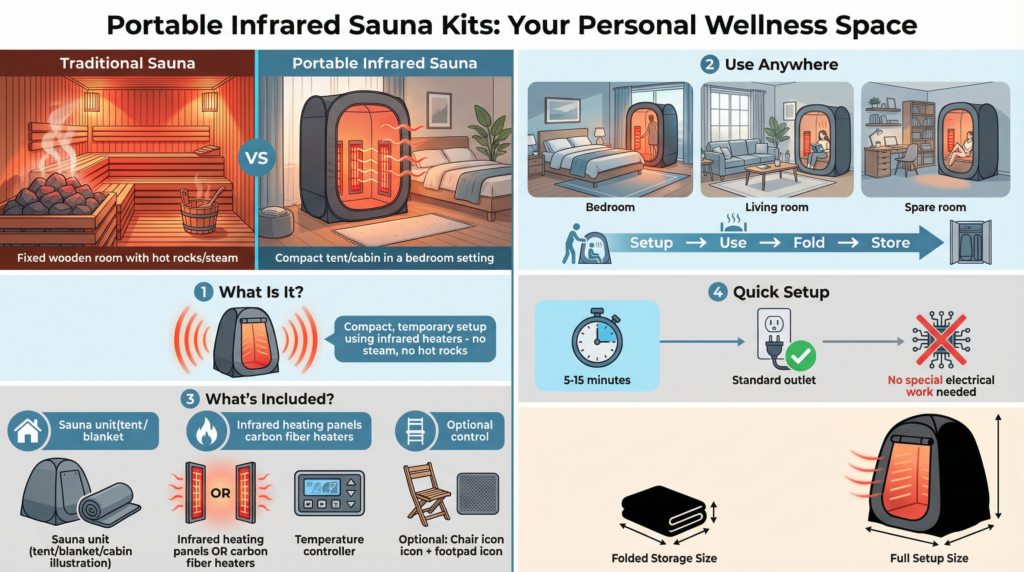
A portable infrared sauna kit is basically a compact, temporary setup that uses infrared heaters instead of traditional steam or hot rocks. You can set it up in your bedroom, living room, or wherever you’ve got space, then fold it up and store it when you’re done.
The “kit” part usually includes the sauna unit itself (tent, blanket, or cabin), infrared heating panels or carbon fiber heaters, and a controller. Some come with chairs or footpads.
Setup typically takes 5-15 minutes, and you don’t need any special electrical work (they run on standard outlets).
How They Work (Infrared vs Traditional Heat)
- Traditional saunas heat the air around you to around 150-195°F. You sweat because the hot air makes your body temperature rise.
- Infrared saunas work differently. They use infrared light waves (far infrared, specifically) that penetrate your skin and heat your body directly.
- The air temperature stays lower, usually 120-150°F, but you still sweat a lot because your core temperature increases.
- Think of it like standing in the sun on a cool day. The air temp might be 65°F, but the sun’s rays warm you up anyway.
That’s basically how infrared works.
Types of Portable Sauna Kits
There are three main types you’ll run into:
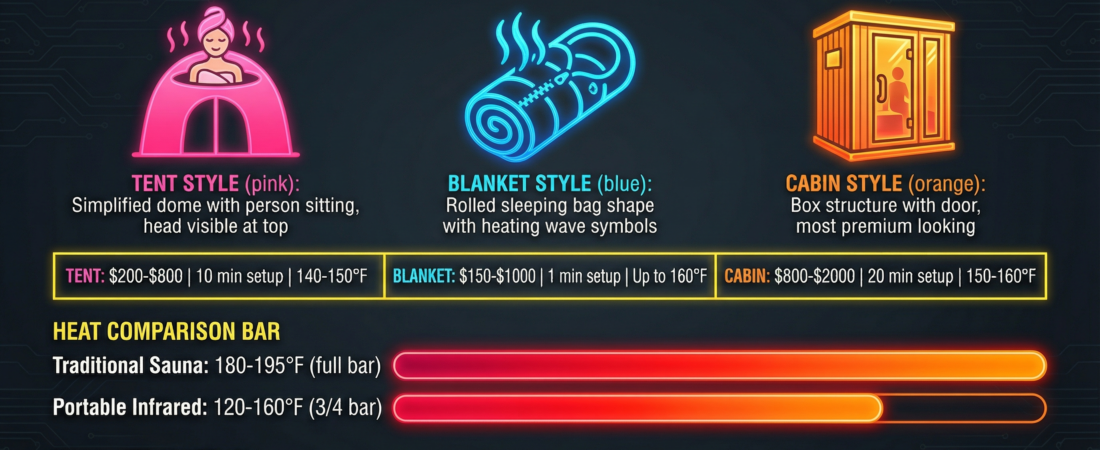
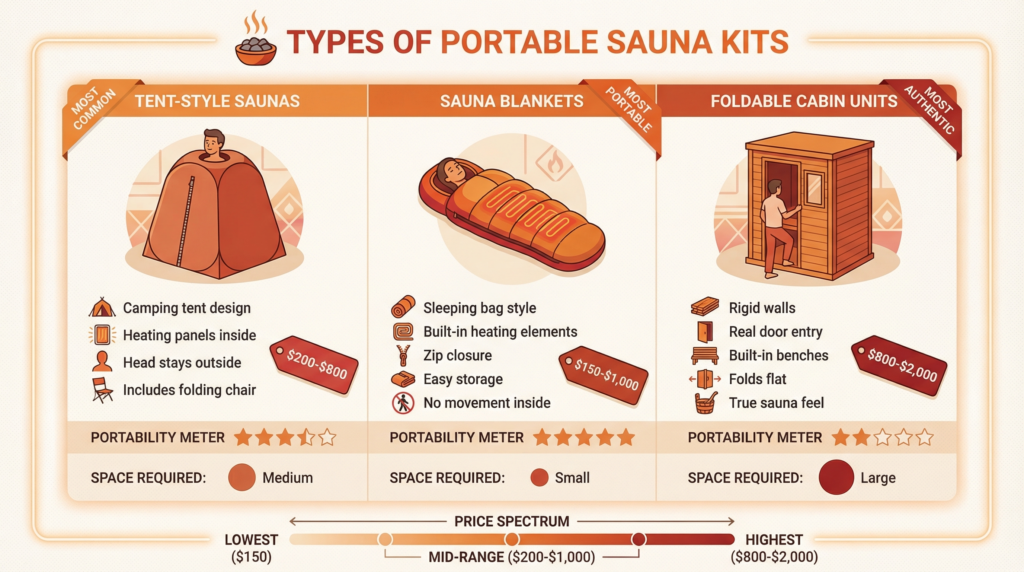
- Tent-style saunas look like camping tents with heating panels inside. Your body sits inside while your head sticks out the top. They usually come with a small folding chair. These are the most common type and range from $200-$800.
- Sauna blankets look like sleeping bags with heating elements built in. You lie down and zip yourself in (your head stays out). They’re super portable and store easily, but you can’t move around. Price range is typically $150-$1000.
- Foldable cabin units are more like actual sauna rooms that fold flat. They have rigid walls, a door, and built-in benches. These are the priciest ($800-$2,000) but feel closest to a real sauna experience.
Do Portable Infrared Sauna Kits Actually Work?
The short answer is yes, but with limitations.
They do get hot enough to make you sweat. They do raise your core body temperature.
And plenty of people report feeling relaxed, experiencing less muscle soreness, and sleeping better after using them regularly.
But they’re not the same as a $5,000 permanent infrared sauna or a traditional Finnish sauna at your gym. The heat isn’t as intense, the experience isn’t as luxurious, and cheaper models have real performance issues.
Heat Output Reality (Key Trust Section)
This is where a lot of people get disappointed. Not all portable saunas heat evenly or get hot enough to feel therapeutic.
Cheaper units (under $200) often struggle to reach 140°F, and even when they do, the heat might be concentrated in one spot while other areas stay lukewarm. This happens because they use fewer heating panels or lower-wattage elements to keep costs down.
Mid-range units ($300-$600) typically have better insulation and more heating panels. They’ll usually hit 140-150°F consistently within 10-15 minutes.
Higher-end portable models ($600+) often feature carbon fiber heaters, better insulation, and many heat zones. These can reach 150-160°F and maintain steady temps.
Here’s the thing though… even the best portable units don’t get as hot as traditional saunas (which run 180-195°F). If you’re used to that intense heat, portable infrared will feel milder.
Sweat vs Traditional Sauna
You will sweat in a portable infrared sauna. Sometimes a lot.
But it feels different than a traditional sauna.
In a traditional sauna, you’re breathing hot, humid air and sweating from environmental heat. It’s intense and can feel overwhelming.
In an infrared sauna, the air stays cooler and easier to breathe. Your body heats from the inside, so you might not feel as hot initially, but you’ll still sweat plenty after 15-20 minutes.
Some people prefer the gentler experience. Others miss the intensity of traditional heat.
What Results You Can Expect
Based on what users consistently report:
You’ll probably feel relaxed and sleep better, especially if you use it regularly (3-4 times per week). The heat seems to help with muscle recovery after workouts, though how much is hard to quantify.
Some people with chronic pain (arthritis, fibromyalgia) report temporary relief, but results vary a lot person to person.
What you probably won’t get: dramatic fat loss (you’re losing water weight, not fat), major detoxification (your liver and kidneys handle that regardless), or secret health transformations.
Types of Portable Infrared Sauna Kits (Comparison)
Let me break down the three main categories so you can figure out which type makes sense for your situation.
Sauna Tents
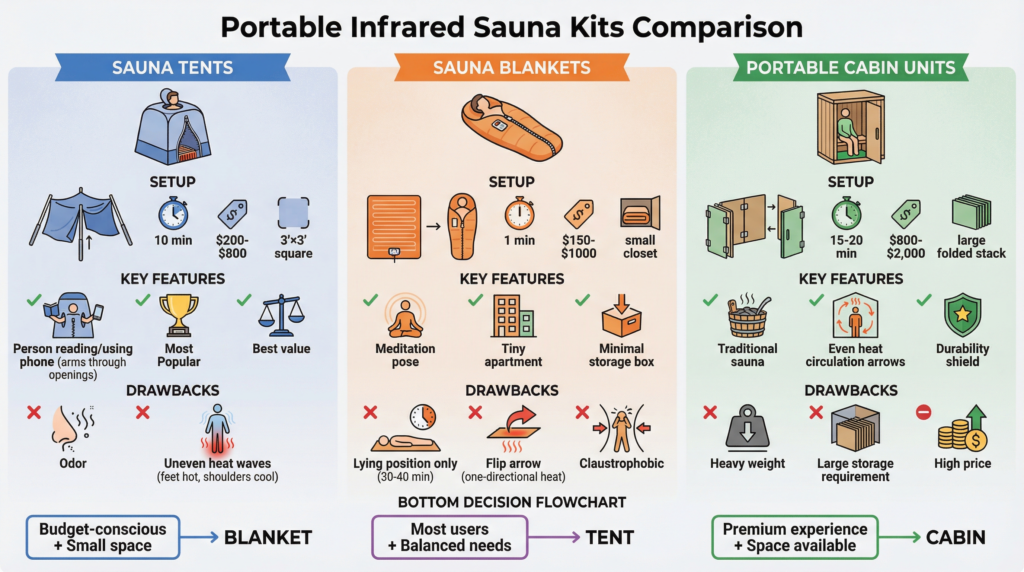
These are the most popular option for good reason. They’re spacious enough to sit comfortably, fold down relatively small, and hit a good balance between price and performance.
You set up the tent frame (usually telescoping poles), drape the insulated fabric over it, plug in the heating panels, and you’re ready to go in about 10 minutes. Most tents have a zippered opening for your head and armholes so you can read or use your phone while you’re in there.
The downsides: they take up floor space when in use (about 3×3 feet), the fabric can develop odors over time if you don’t air it out properly, and some models have really uneven heating (your feet get roasted while your shoulders stay cool).
Sauna Blankets
If space is tight or you want something you can literally store in a closet, blankets make sense.
You lay it flat on your bed or floor, lie down on it, wrap it around yourself, and zip it up. The heating elements are built into the blanket layers.
Setup is basically zero, just plug it in.
The big limitation is that you can’t sit up or move around. You’re lying down for 30-40 minutes.
Some people find this relaxing (like a heated meditation session), others find it claustrophobic or boring.
Also, the heat exposure is more one-directional since you’re lying on one side of the blanket. You’ll want to flip halfway through if you want even heating on your back and front.
Portable Cabin Units
These are basically collapsible sauna rooms. They have rigid walls that fold flat, a real door, and often a built-in bench.
Setup takes longer (15-20 minutes) and they’re heavier to move around, but the experience is way closer to a traditional sauna. You can sit normally, the heat circulates better, and they generally feel more durable.
The catch is price ($800-$2,000) and storage. Even folded flat, they’re bulkier than tents or blankets.
You need space to put them when not in use.
| Type | Price Range | Setup Time | Best For | Limitations |
|---|---|---|---|---|
| Tent | $200-$800 | 10 min | Most people, good balance of portability and experience | Can develop odors, uneven heating in cheap models |
| Blanket | $150-$1000 | 1 min | Tiny apartments, easy storage, meditation-style sessions | Must lie down, one-directional heat, can feel restrictive |
| Cabin | $800-$2,000 | 15-20 min | Those wanting closest experience to real sauna | Expensive, bulky storage, heavier to move |
Best Portable Infrared Sauna Kits (Top Picks)
Some links may be affiliate links, meaning this site may earn commissions on purchases at no additional cost to you.
I’m not going to pretend I’ve personally tested every model on the market, but based on specs, user feedback, and price-to-performance ratios, these are the options that consistently get positive reviews.
SereneLife Portable Full Size Infrared Home Spa
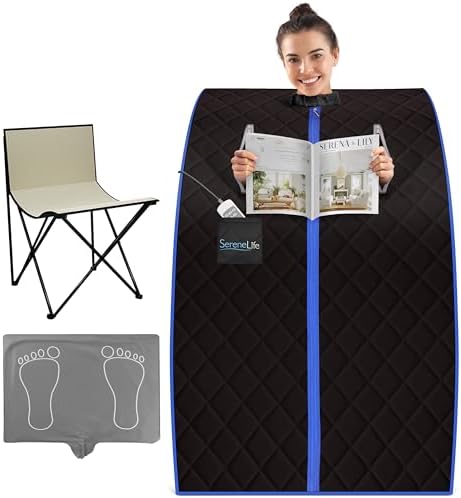
- PERSONAL SAUNA: Can’t get to the spa but want to experience the benefits of sauna therapy? Transform your home into a pe…
- PORTABLE SAUNA UNIT: Whether you have a mobile beauty spa or simply want the flexibility to move your sauna to different…
- ENJOY AND RELAX: Take relaxation to the next level by using our sauna while reading books, listening to music, playing o…
This is a tent-style unit that hits a sweet spot around $250-$300. It comes with a foldable chair, remote control, and six heating panels that cover different body zones.
Best for: People new to infrared saunas who want decent quality without spending $600+
Pros: Heats to about 140-150°F in 15 minutes, reasonably even heat distribution, easy setup, includes a footpad
Cons: The fabric quality isn’t amazing (gets wrinkly and can smell if you don’t air it out), the chair feels flimsy, heat can be inconsistent at the shoulder level
Key specs: 1000W total power, 6 heating panels, reaches 150°F max temp, folds to about 20x20x6 inches for storage
To try infrared sauna sessions at home without a huge investment, this is a pretty solid entry point.
Durherm Low EMF Negative Ion Portable Sauna

- Included: DIF-5000_Copper Sauna, Wired Handheld Controller, Heated Foot-pad, Sports Chair, 2x Terry Cloth Neck, Foam Pad…
- Dimensions: 31.5″ W x 33″ D x 41″ H
- Power: AC 110-120V, 60Hz
This one usually runs $180-$220 and markets itself as a budget-friendly low-EMF option.
Best for: Budget-conscious buyers or those wanting to test the waters before upgrading
Pros: Actually pretty affordable, relatively low EMF readings compared to price point, compact storage
Cons: Takes longer to heat up (20-25 min to hit 135°F), the insulation is mediocre so it loses heat faster, fewer heating panels means less even coverage
Key specs: 800W power, 4 heating panels, max temp around 140°F, advertised EMF below 3mG
This is an okay starter option if you’re on a tight budget, but tbh you’ll probably notice the performance limitations compared to mid-range models.
HigherDOSE Infrared Sauna Blanket

- A Home Sauna, Anywhere – This portable indoor sauna blanket brings the full-body benefits of a traditional sauna into yo…
- Crystal-Infused for Mind-Body Balance – Lined with amethyst, tourmaline, charcoal, and clay, the blanket emits negative …
- Low EMF, High Standards – Unlike typical infrared sauna wraps, our low-EMF blanket is engineered with minimal electromag…
If you’re going the blanket route, HigherDOSE is one of the most popular brands (though also one of the pricier ones at $400-$500).
Best for: Apartment dwellers with zero floor space, people who want easy storage, those who like lying-down heat sessions
Pros: Super easy to use (literally just plug it in and lie down), stores in a closet or under a bed, reaches 160°F, well-insulated so heat stays consistent, waterproof interior
Cons: Can’t sit up or move around, some people feel claustrophobic, the lying-down position doesn’t work for everyone
Key specs: Charcoal and clay layers, reaches 160°F, low-EMF carbon fiber heating, machine-washable insert
The price is steep for a blanket, but the quality is noticeably better than $150 Amazon versions. If a blanket fits your lifestyle, this one seems to hold up well over time.
Radiant Saunas Rejuvenator Portable Sauna
Or
Heat Wave Radiant Saunas BSA6315 Harmony Deluxe Oversized Portable Cabin
This is a tent model in the $250-$450 range with better build quality than most budget options.
Best for: Regular users who want reliable performance and plan to use it 3-4+ times per week
Pros: Hits 150°F consistently, seven carbon heating panels for better coverage, thicker insulation, sturdier frame and chair, includes hand towels and footpad
Cons: Takes up more space when assembled, heavier to move around (about 25 lbs total), the higher price might not be worth it if you only use it occasionally
Key specs: 1350W power, 7 carbon fiber panels, reaches 150°F in 12-15 minutes, low-EMF design
This is probably the best tent option if you’re serious about regular sauna use and want something that’ll last. The extra $100-$150 over budget models gets you noticeably better performance.
Portable Infrared Sauna Kits vs Traditional Saunas
People always want to know how these stack up against “real” saunas. The honest answer is that they’re different tools with different strengths.
Cost Comparison
A traditional or permanent infrared sauna installation runs anywhere from $2,000-$10,000+ depending on size and quality. You need dedicated space, electrical work (often a 240V circuit), and time to install it.
Portable units cost $150-$2,000 and plug into standard outlets. Zero installation.
You can take them with you if you move.
For most people in apartments or rentals, that cost and installation difference is the deciding factor. You’re not choosing between a portable sauna and a permanent one… you’re choosing between a portable sauna and no sauna at all.
Heat and Performance
Traditional saunas get hotter (180-195°F for Finnish saunas, 120-150°F for permanent infrared units). The heat is more consistent and envelops your whole body evenly.
Portable infrared saunas max out around 140-160°F, and cheaper models struggle to heat evenly. The experience is milder and less intense.
If you’re used to gym saunas or luxury spa experiences, portables will feel like a downgrade. If you’ve never done sauna sessions regularly, the difference probably won’t bother you.
Convenience
This is where portables actually win. You can set one up in your bedroom in 10 minutes, use it while watching Netflix or reading, then pack it away.
Traditional saunas need dedicated space that’s always occupied. You can’t really multitask while you’re in there (unless you bring your phone, but the heat isn’t great for electronics).
For busy people who want quick recovery sessions at home without driving to a gym or spa, portables are way more practical.
EMF Safety Explained
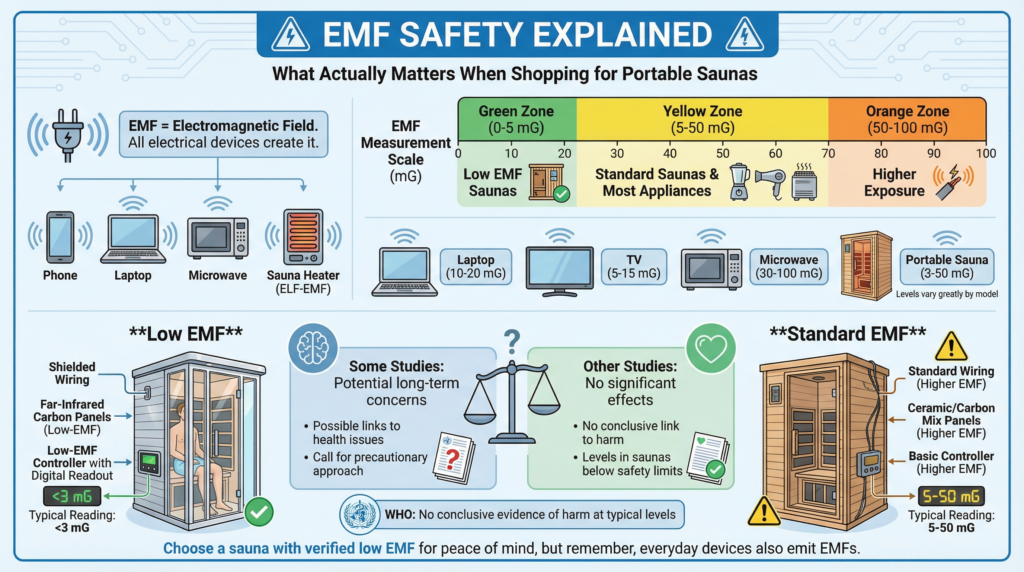
This is probably the most confusing part of shopping for portable infrared saunas. Every brand claims to be “low EMF” but there’s no standardized testing or consistent definitions.
Let me break down what actually matters.
What Is EMF in Infrared Saunas?
EMF stands for electromagnetic field. Any device that uses electricity creates EMF, your phone, laptop, microwave, and yes, infrared heaters.
There are different types of EMF. The one people worry about with saunas is ELF-EMF (extremely low frequency electromagnetic fields), which is what electrical wiring and heating elements produce.
EMF is measured in milligauss (mG). For context, most household appliances produce anywhere from 1-100 mG depending on how close you are to them.
Are Portable Sauna Kits Safe?
The research on EMF health effects is honestly pretty mixed. Some studies suggest long-term, high-level exposure might have health impacts. Other studies find no significant effects.
Regulatory bodies like the WHO say there’s no conclusive evidence of harm at typical exposure levels.
Most portable saunas produce EMF readings between 3-50 mG at body level. That’s comparable to sitting near a laptop or TV.
Are those levels dangerous? Probably not based on current research, but some people prefer to minimize EMF exposure when possible, especially during extended sessions (30-40 minutes in a sauna vs. a few minutes near a microwave).
Low EMF vs Standard Models
“Low EMF” models advertise readings below 5 mG, sometimes below 3 mG. They achieve this through shielding, heater design, or using carbon fiber panels instead of metallic heating elements.
Standard models might have readings of 10-50 mG or higher.
Here’s the practical reality: if EMF concerns keep you up at night, pay extra for verified low-EMF models with third-party testing (not just marketing claims). If you’re generally not worried about EMF from household electronics, standard models are probably fine.
The frustrating part is that most brands don’t provide independent EMF testing results. They just slap “low EMF” on the box.
If a company actually publishes third-party test results showing specific mG readings, that’s a good sign they’re being honest.
How to Choose the Best Portable Infrared Sauna Kit
After sorting through all the options and marketing claims, here’s what actually matters when you’re deciding which one to buy.
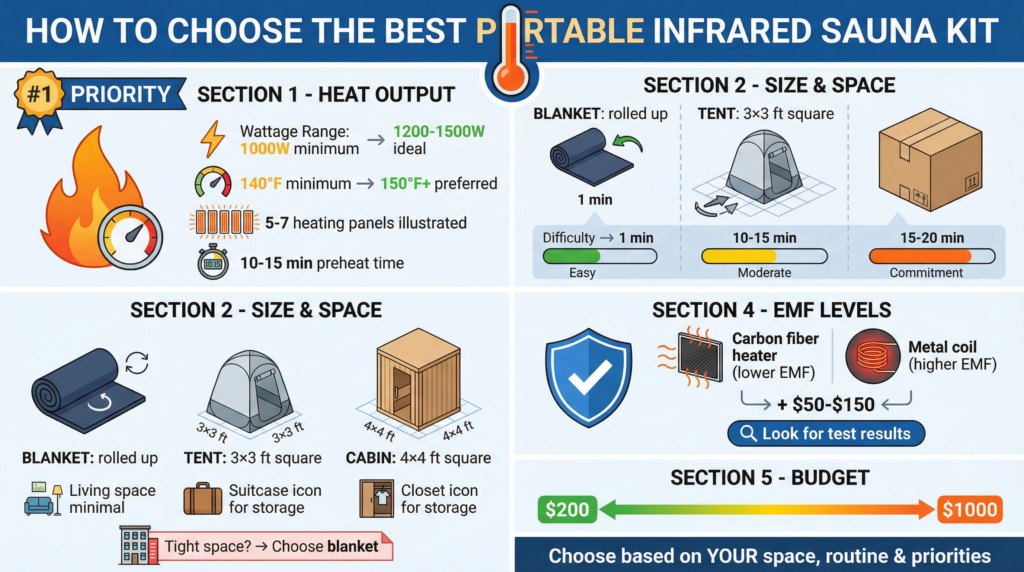
Heat Output (Most Important)
This is the single biggest factor in whether you’ll actually use the sauna regularly and feel like it works.
Look for:
- Wattage: Higher is better. 1000W least, 1200-1500W is ideal for tent models
- Number of heating panels: More panels = more even heating. 5-7 panels for tents, full-body coverage for blankets
- Actual max temperature: Should reach at least 140°F, preferably 150°F
- Preheat time: 10-15 minutes is reasonable, longer than that and you’ll get impatient
Honestly, if a model can’t consistently hit 140°F with even heat distribution, save your money.
Size and Space
Measure where you plan to use it. Tent models need about 3×3 feet of floor space when set up.
Cabin models need more (4×4 feet typically).
Also think about storage. Tents fold down to suitcase-size.
Blankets roll up small.
Cabins fold flat but still take up closet space.
If you’re in a studio apartment or have roommates, a blanket might be your only realistic option.
Portability
How easy is it to set up and take down? Do you plan to move it between rooms or store it after each use?
Blankets win here (literally just unroll and plug in). Tents are pretty manageable (10-15 min setup).
Cabins are more of a commitment (15-20 min setup and they’re heavy).
Think honestly about your routine. If setup takes too long, you’ll stop using it.
EMF Considerations
If this matters to you, look for models that publish actual EMF test results (not just marketing claims). Carbon fiber heaters generally produce lower EMF than metal coil heaters.
Expect to pay $50-$150 more for verified low-EMF models.
Budget
You can find usable portable saunas for $200-$1000.
Common Problems with Portable Infrared Sauna Kits
Let me be real about the issues you might run into. Not all portable saunas are created equal, and some problems pop up consistently with cheaper models.
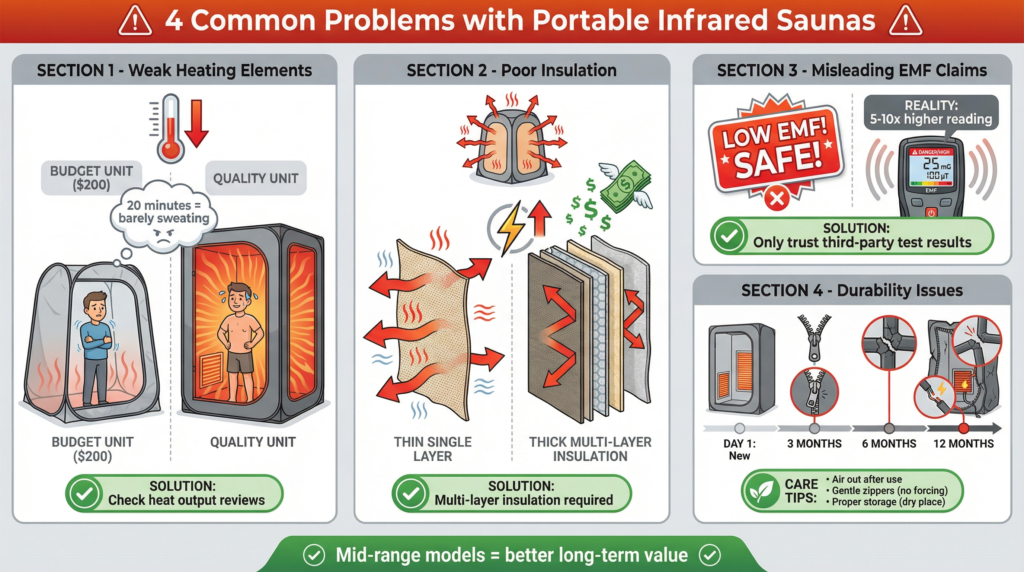
Weak Heating Elements
This is the most common complaint. Budget units (under $200) often have underpowered heaters that take forever to warm up and never quite get hot enough.
You’ll sit in there for 20 minutes barely sweating, wondering if you got scammed. The solution is to avoid bottom-tier models and check reviews specifically mentioning heat output.
Poor Insulation
Even if the heaters are decent, bad insulation means heat escapes constantly. The sauna struggles to reach target temps and burns through electricity trying.
Look for models with many layer insulation (not just thin tent fabric). Thicker material keeps heat in and makes sessions more effective.
Misleading EMF Claims
Tons of brands slap “low EMF” on their marketing without any testing or verification. When people actually measure the EMF with a meter, readings are sometimes 5-10x higher than advertised.
If EMF matters to you, only trust models with published third-party test results. Everything else is just marketing.
Durability Issues
The weakest parts are usually the frame joints (for tents), zippers, and heating panel connections. Cheap models start falling apart after 6-12 months of regular use.
Frames get wobbly, zippers break, heating panels stop working. This is where paying extra for mid-range models actually saves money long-term.
Users who treat their saunas carefully (air them out after each use, don’t yank zippers, store properly) get way longer life out of them.
Who Should Buy a Portable Infrared Sauna Kit?
Portable infrared saunas work well for specific situations and lifestyles. Let me be honest about when they make sense and when they don’t.
Best Use Cases
- You rent an apartment or move often. You can’t install a permanent sauna, but you want regular heat therapy at home. Portable models pack up and move with you.
- You have chronic pain or muscle soreness. Regular heat sessions seem to help some people manage arthritis, fibromyalgia, or post-workout recovery. It’s not a cure, but the temporary relief is enough that people use them consistently.
- You want to try sauna sessions before committing thousands. Starting with a $300 portable let’s you test whether you’ll actually use it regularly before dropping $5k on a permanent installation.
- You have limited space but want wellness tools at home. A sauna blanket stores in a closet. A tent folds into a corner. Compare that to the floor space a treadmill or squat rack takes up.
- You value convenience over luxury. Being able to do a 30-minute session while watching TV at 10pm beats driving to a gym or spa.
Who Should Avoid Them
- If you’re expecting a spa-quality experience, you’ll be disappointed. Portable saunas are more utilitarian. They work, but they’re not luxurious.
- If you have serious medical conditions, talk to a doctor before using any sauna. Heat therapy isn’t safe for everyone (especially people with cardiovascular issues, pregnant women, or anyone with heat sensitivity).
- If you hate being hot or get claustrophobic easily, portable saunas might be uncomfortable. The enclosed space and sustained heat aren’t for everyone.
- And honestly, if you know you’re the type to buy fitness equipment that ends up collecting dust, maybe try a sauna at a gym or spa first before buying one for home.
Are Portable Infrared Sauna Kits Worth It? (Verdict)
For the right person in the right situation, yeah, they’re worth it.
- If you want regular heat therapy at home, can’t install a permanent sauna, and set realistic expectations, a decent portable infrared sauna ($300-$700 range) will probably get regular use.
- The key is understanding what you’re getting. This is not a $5,000 luxury sauna experience.
- The heat is milder, the materials are less durable, and cheaper models have real performance issues.
- But for apartment dwellers, renters, or anyone who wants convenient at-home sessions without major installation, they fill a real need.
My advice: skip the ultra-budget models under $200 (they’re frustrating to use), invest in something mid-range ($300-$700), and use it consistently for at least a month before deciding if it was worth the money.
Most people who buy quality portable saunas and actually use them regularly seem pretty happy with the purchase. The ones who regret it usually either bought cheap models that didn’t work well or had unrealistic expectations about what portables can do.
If you’ve been on the fence about trying one, a mid-range tent model is probably your best bet for balancing cost, performance, and convenience.
FAQ (Featured Snippet Section)
Do portable infrared sauna kits get hot enough?
Decent models reach 140-150°F, which is hot enough to make you sweat and raise core body temperature. This is cooler than traditional saunas (180-195°F) but still effective for most people.
Budget models under $200 often struggle to hit 140°F consistently.
Are they safe to use daily?
For most healthy adults, yes. Many people use them 3-5 times per week without issues.
Sessions typically last 20-40 minutes.
However, people with cardiovascular conditions, pregnant women, or anyone with heat sensitivity should ask a doctor first. Staying hydrated is important.
Do they help with pain relief?
Some users report temporary relief from arthritis, muscle soreness, and fibromyalgia symptoms. The heat increases circulation and may reduce inflammation short-term.
Results vary person to person, and there’s no guarantee of therapeutic benefits.
It’s not a replacement for medical treatment.
Are they good for small apartments?
Yes, especially blanket-style models that store in closets or under beds. Tent models need about 3×3 feet of floor space during use but fold down to suitcase-size for storage. They plug into standard outlets and need no installation.
How long should you use one?
Most people do 20-40 minute sessions. Start with 15-20 minutes if you’re new to sauna use, then gradually increase.
Sessions longer than 45 minutes aren’t necessarily better and can lead to dehydration.
Are low-EMF models necessary?
That depends on your personal EMF concerns. Standard models produce 10-50 mG, low-EMF models produce under 5 mG.
Current research doesn’t show definitive health risks at those levels, but some people prefer minimizing exposure.
If EMF worries you, pay extra for verified low-EMF models with published test results.
Can you lose weight using portable infrared saunas?
You’ll lose water weight from sweating, but that comes back when you rehydrate (which you should do after every session). There’s no evidence they burn significant calories or fat.
Some people use them as part of a broader wellness routine, but they’re not a fat loss tool on their own.
What’s the difference between a sauna tent and a sauna blanket?
Tents let you sit upright with your head out the top (like a camping tent with heaters inside). Blankets need lying down wrapped inside (like a heated sleeping bag).
Tents offer more even full-body heat and feel less restrictive.
Blankets store easier and cost less but limit movement.
The bottom line is that portable infrared sauna kits work well for people who understand their limitations and choose quality models. They’re not secret devices, but they offer a practical way to get regular heat therapy at home without spending thousands or renovating your space.
For most people reading this, a mid-range tent sauna ($350-$600) will give you the best balance of performance, durability, and value. If space is really tight, a quality blanket ($300-$1000) gets the job done.
Just avoid the ultra-cheap models that promise the same results for half the price… you’ll end up disappointed and out the money anyway.
Still Looking? Use out Portable Infrared Sauna Kit Buyers Tool
You May Also Be Interested In These Articles:
This guide provides educational information for selecting portable infrared sauna kits. Some links may be affiliate links, meaning this site may earn commissions on purchases at no additional cost to you.
Disclaimer: The wellness benefits described are based on general research and user experiences. Individual results may vary as these are only opinions. Consult with a healthcare professional before beginning any new wellness routine, especially if you have pre-existing medical conditions, are pregnant, or take medications. Infrared sauna use is not intended to diagnose, treat, cure, or prevent any disease.