What Makes Sun Home Different
We will answer that in this Sun Home Saunas review. Brands like Sun Home Saunas position themselves very well in the portable infrared sauna market. Sun Home Saunas builds pre-assembled infrared saunas that plug into regular outlets (mostly) and don’t need permanent installation. That matters if you rent, live in an apartment, or just don’t want to commit to sawing holes in your walls.
One of the hottest new things in health and wellness are portable infrared sauna kits for those at home with small spaces. The infrared sauna market has gotten crowded with all the hype.
You’ve got less expensive portable infrared boxes, tents, and domes that are very useful for those that live in small apartments and urban dwellers. Then you’ve got portable infrared sauna cabins made of wood like Sun Home Saunas that can fit small spaces.
This sun home saunas review breaks down what you’re actually paying for and whether it lines up with what you need. The company focuses on three main selling points: full-spectrum infrared heating, low EMF exposure, and faster heating times than competitors.
Table of Content
Sun Home Saunas Product Lineup (Indoor Infrared Models)
Sun Home focuses on premium infrared sauna systems designed for home use. Their lineup mainly splits into two categories:
- Far-infrared indoor saunas (more traditional infrared approach)
- Full-spectrum infrared indoor saunas (flagship models)
They emphasize high heat output, multi-heater placement, and lower EMF claims compared with budget brands.
SunHome Saunas Product Lineup Breakdown
1. SunHome Far Infrared Pod (Entry-Level Far Infrared)
Type: Far infrared only (portable / compact system)
What it is:
A compact, space-saving personal sauna designed for smaller homes or apartments. Focused purely on far infrared heat therapy.
What it offers:
- Far infrared carbon heaters
- Compact footprint for tight spaces
- Lower temperature operation with deep heat penetration
- Quick heat-up time
- Energy efficient
- Budget-friendly entry option
- Simple setup and minimal installation
Best for:
- First-time sauna buyers
- Apartment dwellers
- Recovery and detox use
- Users wanting basic infrared therapy
Position in lineup:
Entry-level / most affordable SunHome solution.
2. Infrared Solstice (Premium Far Infrared Cabin)
Type: Far infrared indoor cabin
What it is:
A traditional cabin-style far infrared sauna with stronger performance, better materials, and improved insulation compared to the pod.
What it offers:
- High-output far infrared heaters
- Solid wood construction (premium interior finish)
- Better heat retention than portable units
- Digital controls
- Chromotherapy lighting
- Larger interior space
- Higher max temperatures than entry models
Best for:
- Dedicated home wellness setups
- Frequent sauna users
- Stronger sweating and heat therapy
- Users wanting a permanent indoor sauna
Position in lineup:
Mid-tier indoor far infrared system.
3. Eclipse (Red Light + Infrared Hybrid)
Type: Far infrared + red light therapy combination
What it is:
A hybrid sauna combining traditional infrared heat with medical-grade red light therapy for recovery and skin benefits.
What it offers:
- Far infrared heat panels
- Integrated red light therapy
- Muscle recovery support
- Skin health benefits
- Anti-inflammatory applications
- Enhanced wellness and biohacking features
- Premium control systems
Best for:
- Performance recovery
- Biohackers
- Skin and anti-aging benefits
- Multi-modality therapy users
Position in lineup:
Advanced hybrid wellness system.
4. Equinox (Full Spectrum Infrared Sauna)
Type: Full spectrum infrared (near + mid + far)
What it is:
SunHome’s flagship indoor sauna offering complete infrared coverage across all wavelengths.
What it offers:
- Near infrared (skin + healing)
- Mid infrared (circulation + tissue heating)
- Far infrared (deep detox sweating)
- Medical-grade heater technology
- Premium wood cabin construction
- Advanced insulation
- Chromotherapy lighting
- High heat output
- Full therapeutic coverage
Best for:
- Maximum therapeutic benefits
- Clinical-level home use
- Full-body wellness optimization
- Users wanting the most advanced indoor system
Position in lineup:
Top-tier indoor flagship.
5. Sun Home Saunas Infrared Sauna Blanket (Entry Level)
Type:Infrared sauna blanket – a portable heat therapy system that uses far-infrared radiation to warm the body while you lie inside, typically zip-closed like a sleeping bag or wrap.
This type of system is an alternative to cabin-style saunas, focusing on direct body heating without the need for a full enclosure.
What It Is
The Sun Home Saunas Infrared Sauna Blanket is a portable infrared heat therapy device designed to:
- Deliver far-infrared heat directly to the body
- Use in-home or travel settings
- Provide sauna-style thermal exposure without a rigid sauna cabin
- Be stored easily, rolled up, or tucked away when not in use
Unlike traditional sauna tents or cabins, a sauna blanket creates a heat “wrap” environment, concentrating infrared energy around your body without heating the surrounding air as much.
What It Offers
Infrared Heat Technology
- Far-infrared heat panels embedded within the blanket
- Adjustable heat levels for personalized sessions
- Thermostatic temperature control
Here, the infrared elements are designed to warm your body directly, increasing core temperature while maintaining a relatively lower ambient environment.
Portable Design
- Folds or rolls up for storage
- Requires minimal space
- Easy to set up and transport
This makes it ideal for renters or apartment dwellers who can’t install a sauna cabin or want a space-efficient solution.
User Controls
- Digital controller (commonly included)
- Adjustable temperature settings
- Session timers for safety and convenience
Comfort Features
- Insulated interior for heat retention
- Soft outer fabric for user comfort
- Often designed with safety cut-offs and heat sensors
Best For:
- Low-impact heat exposure
- Calming heat sessions
- Warmth without extreme temperature levels
- General wellness and relaxation
- Supplementing recovery routines
- Small spaces and portable needs
- Apartment dwellers
- Renters
- Travelers
- Individuals without space for a sauna cabin
Because it takes up little room and requires no permanent installation, it fits easily into small living environments.
Budget-Friendly Infrared Option
Infrared sauna blankets are typically less expensive than full cabins or tent systems, making them a cost-conscious choice for:
- First-time sauna buyers
- Users wanting infrared exposure on a limited budget
Outdoor Models
6. Luminar (Outdoor Infrared Sauna)
Type: Outdoor far or full spectrum (weather-resistant cabin)
What it is:
An outdoor-rated sauna designed for patios, backyards, or outdoor wellness spaces.
What it offers:
- Weather-resistant exterior construction
- Outdoor insulation design
- High-powered infrared heaters
- Larger seating capacity
- Premium cabin experience
- Year-round use capability
- Strong heat performance in cooler climates
Best for:
- Backyard spa setups
- Dedicated outdoor wellness spaces
- Higher capacity use
Position in lineup:
Premium outdoor sauna option.
7. Solaris (Luxury Outdoor Sauna System)
Type: Luxury outdoor infrared sauna
What it is:
SunHome’s most premium outdoor system with upgraded design, performance, and capacity.
What it offers:
- High-end architectural design
- Advanced insulation and durability
- Larger multi-person capacity
- Premium materials
- Enhanced heating power
- Spa-level outdoor experience
Best for:
- Luxury home installations
- Multi-user households
- High-end outdoor wellness setups
Position in lineup:
Highest-end outdoor model.
Simple Hierarchy of the Lineup (Quick View)
Entry → Advanced progression:
- Infrared Sauna Blanket → luxury infrared blanket
- Far Infrared Pod → portable / entry
- Solstice → premium far infrared cabin
- Eclipse → infrared + red light hybrid
- Equinox → full spectrum flagship
- Luminar → outdoor system
- Solaris → luxury outdoor system
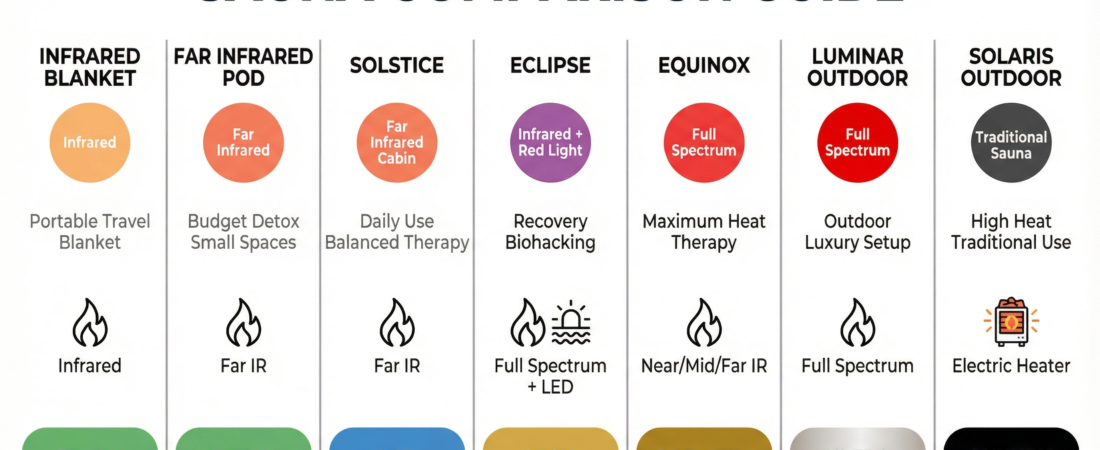
Sun Home Saunas Comparison Table
| Model | Technology | Best For | Heat Type | Premium Level |
|---|---|---|---|---|
| Infrared Blanket | Infrared | Portable travel blanket | Infrared | Premium Entry |
| Far Infrared Pod | Far infrared | Budget detox, small spaces | Far IR | Entry |
| Solstice | Far infrared cabin | Daily use, balanced therapy | Far IR | Mid |
| Eclipse | Infrared + red light | Recovery, biohacking | Full spectrum + LED | High |
| Equinox | Full spectrum | Maximum heat therapy | Near/Mid/Far IR | Premium |
| Luminar Outdoor | Full spectrum | Outdoor luxury setup | Full spectrum | Ultra |
| Solaris Outdoor | Traditional sauna | High heat traditional use | Electric heater | Luxury |
Which Model Is Best by Goal?
Best for Urban Dwellings and Small Spaces
Top Picks:
- Far Infrared Pod — budget detox option
- Solstice — consistent daily sweating
- Equinox — deeper heat and higher temps
- Infrared Blanket — best for small spaces and portablity
Why:
- Space saving
- 1, 2, 3 person
- Premium Quality
Best for Detox
Top picks:
- Equinox — deeper heat and higher temps
- Solstice — consistent daily sweating
- Far Infrared Pod — budget detox option
Why:
- Longer sessions
- Consistent heat distribution
- Higher temperature capability
Best for Recovery / Performance
Top picks:
- Eclipse (clear winner)
- Equinox
- Luminar Outdoor
Why:
- Multi-therapy design
- Larger interiors
- Strong heat output
Best for Biohacking / Advanced Users
Top picks:
- Eclipse (multi-modal therapy)
- Equinox (full spectrum focus)
- Luminar Outdoor (high-end setup)
Why:
- Multiple wavelengths
- High wattage heaters
- Advanced feature sets
Key Differences: Full-Spectrum vs Far Infrared (Sun Home)
| Feature | Full-Spectrum Models | Far-Infrared Models |
|---|---|---|
| Heat wavelengths | Near + Mid + Far | Far only |
| Heat output | Higher | Moderate |
| Heat distribution | More even | Panel-based |
| Warm-up speed | Faster | Slower |
| Price | Premium tier | Lower cost |
| Technology complexity | High | Standard |
| Target user | Performance / biohacking | Relaxation / entry level |
What Sun Home Tries to Differentiate On
Across their lineup, the company emphasizes:
- High wattage heaters
- Multi-placement heater layout
- Faster heat-up vs traditional saunas
- Low EMF positioning (brand claim)
- Premium wood construction
- Even heat distribution
- Luxury wellness features (audio, lighting, design)
Their positioning is premium home wellness equipment, not budget portable units.
Simple Hierarchy of the Lineup for Entry (Quick View)
Entry → Advanced progression:
- Infrared Sauna blanket→ portable/ entry
- Far Infrared Pod → portable / entry
- Solstice → premium far infrared cabin / entry
- Eclipse → infrared + red light hybrid
- Equinox → full spectrum flagship
- Luminar → outdoor system
- Solaris → luxury outdoor system
Heating Technology Breakdown
This is where Sun Home tries to differentiate itself from the competition.
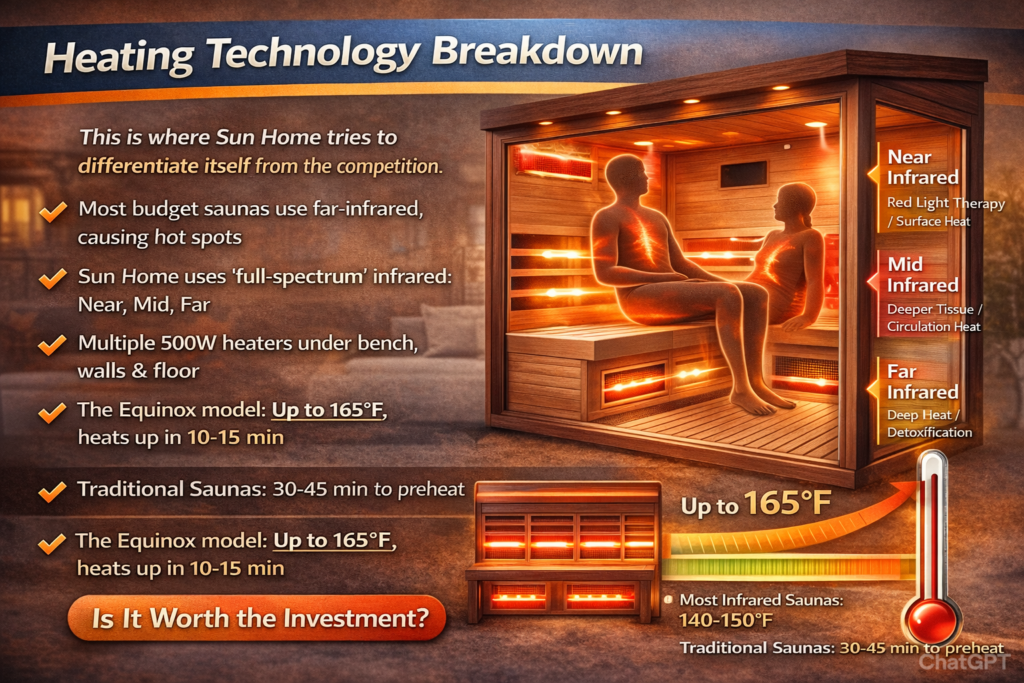
Most budget infrared saunas use far-infrared heating panels. They work fine, but they tend to create hot spots right in front of the panels and cooler zones everywhere else.
Sun Home uses what they call “full-spectrum” infrared, which combines near, mid, and far infrared wavelengths.
I’ll be honest, the science on whether full-spectrum provides measurably better results than far-infrared alone is still pretty unclear. The marketing around infrared wavelengths gets fuzzy fast. But the practical difference is in how they distribute the heaters.
Sun Home models have multiple heater placements, under benches, along walls, at calf height, on the floor. The Solstice has 8 heaters. The Luminar Outdoor has 15. That many heat sources helps avoid the uneven heating problem where your front is roasting but your back is barely warm.
Each heater puts out 500 watts, which Sun Home claims is double what most competitors use. More wattage means faster heating and higher max temps.
The Equinox reaches 165°F, while most infrared saunas top out around 140-150°F.
Traditional saunas hit 180-195°F, so if you want that intense heat experience, infrared still falls short. But the tradeoff is speed. Sun Home models heat up in 10-15 minutes.
Traditional saunas need 30-45 minutes just to preheat. For people who want to hop in after a workout without waiting around forever, that speed matters.
The EMF Thing (And Why It’s Confusing)
Sun Home makes a big deal about their EMF and ELF shielding. They claim the lowest electromagnetic field levels in the industry.
Here’s the problem: there’s no standardized testing for EMF levels across sauna brands. Companies test their own products using their own methods.
Sun Home takes EMF serious and says theirs is the lowest. If you’re someone who worries about EMF exposure from electronics, Sun Home’s engineering around this might matter to you. If you think the whole EMF concern is overblown, it’s just another marketing point.
The reality is Sun Home does engineer their heaters with shielding, which adds to the cost. Whether that’s worth paying extra for depends entirely on how seriously you take the EMF debate.
Build Quality and Materials
Most Sun Home models use eco-certified eucalyptus or carbonized cedar. The outdoor Luminar line uses aerospace-grade aluminum for the exterior shell.
Cedar naturally has antimicrobial properties, which is a nice bonus. It also smells good when heated, which adds to the experience.
The outdoor models have double-pane glass insulation and weatherproofing that let’s them sit outside year-round without falling apart. That engineering adds weight and cost, but it also means you’re not replacing rotted wood panels in three years.
The Pod uses tempered glass on the front panel, which looks sleek and serves a functional purpose, you can see out, so you don’t feel trapped in a tiny cylinder.
Overall, the materials feel intentional. They’re not using the cheapest wood they can source.
Whether that justifies a 40-60% price increase over budget brands is debatable, but the quality difference is noticeable.
| Model | Capacity | Dimensions | Weight | Heaters | Max Temp | Power |
| Sun Home Pod | 1 Person | 36″ diameter | 385 lbs | 6 heaters | 160°F | 120V standard |
| Equinox 2-Person | 2 People | 45.4″W x 39.9″D | ~450 lbs | 7-8 heaters | 165°F | 120V standard |
| Solstice 3-Person | 3 People | ~60″W x 48″D | ~600 lbs | 8-10 heaters | 165°F | 120V standard |
| Luminar Outdoor 5 | 5 People | 82.25″W x 51.75″D | 1,270 lbs | 15 heaters | 170°F | 240V 30amp |
Setup and Installation
By far the easiest is the Sun Home Sauna Infrared Blanket for ease of use (unroll and plug in), portability, and entry into the heat therapy market.
Most Sun Home models plug into standard 120V outlets. The Pod and Equinox take 10-20 minutes to assemble.
The panels are modular, so you’re basically connecting pre-built pieces without needing power tools or construction skills.
The Solstice takes a bit longer, maybe 30-45 minutes, but it’s still straightforward.
The Luminar Outdoor is the exception. It needs a 240V 30-amp circuit, which means you’ll need an electrician to run the proper wiring.
It also weighs over 1,200 pounds, so you’ll want at least two people handling the setup.
But even that takes 2-3 hours max, which is nothing compared to building a traditional sauna from scratch.
The plug-and-play setup is probably the biggest practical advantage of these units. Traditional saunas need construction allows, ventilation systems, dedicated circuits, and contractor labor.
That adds thousands to the final cost.
With Sun Home, you’re unpacking boxes, putting it together and plugging things in. If you move, you can take it with you (assuming you’ve got help moving the heavier models).
Performance, Does It Actually Work?
The big question is whether these units deliver consistent heat without cold spots or long wait times.
From what people report, the multi-heater placement does solve the uneven heating problem that plagues cheaper infrared saunas. When you’ve got 8-15 heaters surrounding the cabin interior, you don’t get those dead zones where your back stays cool while your front roasts.
The preheat time really is 10-15 minutes for most models. That’s fast enough that you can decide to use it on a whim without planning your whole evening around it.
Session duration is different from traditional saunas. Traditional saunas are intense, you sit for 10-20 minutes, cool down, and repeat.
Infrared saunas run at lower temps, so you can sit for 30-45 minutes continuously without it feeling unbearable.
That extended session length works better for people using saunas for recovery routines or chronic pain management. The gentler heat sustained over longer periods fits that use case better than short bursts of intense heat.
Temperature maintenance stays consistent once the unit reaches target temp. The insulation on the outdoor models is particularly good, the aerospace aluminum and double-pane glass keep heat from escaping even in cold weather.
The one limitation is max temperature. Even the highest-end Luminar Outdoor tops out around 170°F.
Traditional saunas hit 180-195°F easily.
If you specifically want that scorching heat experience, infrared won’t deliver it.
But for most people, 160-170°F is plenty warm, especially when you’re sitting in it for 30+ minutes.
If you’re curious about trying out the compact option, you can check out the Sun Home Pod here, it’s the entry point into their lineup without committing to a multi-person model.
What Works Well
Fast operation, The infrared sauna blanket is fast, easy to use and portable, you’ll love it. Furthermore, Sun Home Sauna’s other models only take 10-15 minute preheat saves a ton of time if you’re using this daily or after workouts. You don’t need to plan ahead.
Energy efficiency, Infrared saunas use about 0.5-1.5 kWh per session. Traditional saunas use 3-6 kWh.
If you’re using this every day, that difference adds up on your electric bill.
Space flexibility, The Pod works in apartments. The Equinox fits small homes.
The outdoor Luminar doesn’t steal space inside your house.
That flexibility opens up at-home sauna use for people who couldn’t do it before.
Low maintenance, You’re not replacing heating stones or cleaning ventilation systems. Occasional panel cleaning and rare element replacement is about it.
That removes a lot of friction from long-term ownership.
Material quality, Eco-certified wood, antimicrobial cedar, aerospace aluminum on outdoor models. The materials feel premium, not bargain-bin.
Multiple heaters, The 8-15 heater placement strategy actually addresses a real problem with budget infrared saunas. Heat distribution matters.
What You May Not Like
Single-user capacity on entry models, The Pod only fits one person. To use it with a partner or friend, you’re stuck with the larger (and pricier) models.
Premium pricing, Sun Home models range from roughly $5,000 to $10,000 depending on size. That’s expensive.
Budget infrared saunas start around $1,000 unless you start with infrared blanket.
Traditional saunas vary wildly, but installation costs often exceed the unit cost.
Lower max temps, If you want traditional sauna heat above 180°F, infrared won’t get there. The highest Sun Home models hit 170°F.
Feature complexity, Smartphone connectivity, chromotherapy lighting, Bluetooth audio. Some people want simple temperature controls without the tech overhead.
You’re paying for features you might never use.
Heavy weight on outdoor models, 1,270 pounds means you need to plan placement carefully. Once it’s set up, you’re not moving it without serious effort.
Who This Actually Makes Sense For
- Renters and apartment dwellers who can’t install permanent saunas but want at-home access. The Infrared Blanket, Pod, Solstice and Equinox solve a problem that didn’t have good solutions before.
- People using saunas daily for recovery routines. The fast preheat and lower operating costs favor frequent use.
- If you’re hopping in after every workout or using it as part of a structured wellness routine, the efficiency advantages compound quickly.
- Households with outdoor space who want multi-person capacity. The Luminar line turns your backyard into a wellness space without sacrificing interior square footage.
- People managing chronic pain who benefit from extended, gentler heat sessions. The 30-45 minute session capability at moderate temps aligns better with therapeutic use than short, intense traditional sauna sessions.
- Homeowners who want premium materials and engineering but don’t want construction complexity. You’re getting quality components without allows and contractors.
- For a mid-range option that balances size and features, the Sun Home Equinox 2-Person hits a sweet spot between the compact Pod and the larger Solstice models.
Who Should Skip These
- People who specifically want traditional sauna heat above 180°F. Infrared won’t deliver that experience.
- Casual users who want sauna access a few times a month. The premium pricing is harder to justify if you’re not using it often.
- Budget infrared options or gym memberships might make more sense unless you start with the infrared blanket.
- Buyers on tight budgets. You can find functional infrared saunas for half the price unless you start with the infrared blanket- which is a great option.
- People who want barebones simplicity. If smartphone apps and chromotherapy lighting feel like unnecessary complexity, you’re paying for stuff you don’t want unless you go for the blanket.
Pricing Breakdown, What You’re Actually Spending
Blanket, around$500 and its a great entry point for home heat therapy.
Pod, Around $6500 depending on sales. This is the entry point.
You’re getting infrared therapy in a space-efficient package without premium features.
Equinox 2-Person, $6700. This is the value sweet spot for most people.
Couples can use it, the build quality is solid, and it includes full-spectrum heating.
Solstice 3-Person, $6900. Intermediate capacity with high heater counts.
Good for households where multiple people want regular access.
Luminar Outdoor, $14499. Premium pricing reflects weatherized construction, aerospace aluminum, and multi-person capacity.
This is for people who want the best option Sun Home offers and have the outdoor space to use it.
The cost-benefit calculation shifts based on how often you use it. Daily users probably break even on energy savings within 2-3 years compared to traditional saunas.
Occasional users never recoup the premium through operating cost savings.
The pricing reflects the full package, materials, engineering, EMF shielding, control systems, warranty support. Whether that justifies the cost depends on what you value and how you plan to use it.
How This Compares to Alternatives
- Traditional saunas need electricians, allows, construction, and dedicated room space. Installation costs often match or exceed the unit cost.
- Operating costs run higher.
- Maintenance is more involved.
- But traditional saunas deliver higher temps and the classic sauna experience. If that’s what you want, infrared isn’t a substitute.
- Budget infrared saunas from brands flooding Amazon cost $1,000-$2,000. They work, but build quality varies wildly.
- Heater counts are lower.
- EMF shielding is minimal or nonexistent. Heat distribution tends to be uneven.
- Mid-tier infrared brands like Sunlighten and Clearlight compete directly with Sun Home in the $3,000-$7,000 range. Features and quality are comparable.
- Choosing between them often comes down to specific model features and aesthetic preferences.
- High-end Finnish sauna brands like Finnleo or Tylö offer premium traditional saunas starting around $5,000 and going up from there. Different technology, different experience.
- Sun Home sits in the premium infrared category. You’re paying more than budget options but getting better materials, more heaters, and thoughtful engineering.
- Whether that’s worth it depends on your priorities and budget.
The Bottom Line
This sun home saunas review comes down to a pretty straightforward question: are you willing to pay premium prices for premium features in an infrared sauna or infrared blanket?
Sun Home delivers on the practical promises. Fast preheat, consistent heat, low maintenance, space flexibility.
The multi-heater placement addresses real problems with cheaper infrared units.
The materials are quality. The engineering is thoughtful.
The full-spectrum heating and EMF shielding represent real design decisions, even if independent verification of claimed advantages is hard to find.
For renters and apartment dwellers, Sun Home solves a before unsolvable problem. You can have at-home infrared therapy without permanent installation or construction.
For daily users focused on recovery routines, the operational advantages justify the upfront cost. Fast preheat and extended session capability fit structured wellness routines better than traditional saunas.
The premium pricing reflects legitimate quality indicators. Whether you want to pay 40-60% more than budget choices depends entirely on how much you value those quality improvements.
Buyers treating this as essential daily recovery equipment find the investment worthwhile. Buyers wanting occasional thermal relaxation find the cost harder to justify.
The most realistic value sits between those extremes. Sun Home offers a moderately-priced entry into serious at-home infrared sauna ownership for people with space and electrical constraints that ruled out traditional systems entirely.
If you’re ready to commit to one, the complete Sun Home lineup is available here with detailed specs for each model.
The company positions itself in the premium infrared market through intentional choices as opposed to competing on price alone. That appeals to people willing to pay for quality and sophistication.
The realistic assessment is that Sun Home saunas work as advertised. They install quickly, operate efficiently, and maintain heat consistently. The limitations are inherent to infrared technology, lower max temps than traditional saunas and premium pricing compared to budget options.
For people using saunas as part of daily wellness routines, dealing with chronic pain, or living in spaces where traditional installation isn’t possible, Sun Home offers a solid solution that balances performance with practicality. We hope we have answered your questions in this Sun Home Saunas Reviews and believe this Sun Home Saunas Review will make your purchasing decisions easier.